Looking back, it’s been approximately eight years since I played the Resistance games. Like most games, I missed their time in the spotlight, but hey, they were still worth playing.
Years ago, during a PlayStation Network flash sale, I picked up Kurulin Fusion for a buck. A block-matching puzzle game for the PlayStation Portable, its sole claim to fame is the fact that Nobuo Uematsu served as musical director. The legendary composer, best known for his involvement with the Final Fantasy series, didn’t actually contribute any music for this game, however. Instead he provided instruction to Kenichiro Iwasaki, who arranged techno remixes of classic Johann Sebastian Bach compositions. Regardless of Uematsu’s level of involvement, the soundtrack was a delight and full of hummable earworms. The game, on the other hand… Continue reading Kurulin Fusion [PlayStation Portable] – Review→
When I played Star Ocean: First Departure earlier this year, I came away disappointed. I was looking forward to an epic sci-fi JRPG and instead encountered a brief fantasy tale wrapped in a sci-fi veneer. My eagerness to bask in the series wasn’t washed away however and I promptly began the follow-up Star Ocean: Second Evolution. Another remake for the PSP, this one was of Star Ocean: The Second Story which originally released on the PlayStation in North America in 1999. This version was released ten years later and left me with many of the same grievances, but I wound up enjoying it more.
Much everything remained the same from the previous remake.
Of the Star Ocean games released to date, this is the only one to serve as a direct sequel to another. Set twenty years after the events of First Departure, this game is primarily the tale of Claude Kenny, the son of one of the original protagonists. I say primarily because players can also choose Rena Lanford as the centerpiece of the game. Both characters embark on a journey of self-discovery and their paths cross very early on at which point they remain together through the end. Having done a single playthrough I can’t comment on the differences caused by picking the other, but since they join up so early on, I can’t imagine there’s much uniqueness.
Pretty quickly after starting, Claude gets separated from his father’s Federation crew and he’s left to fend for himself on a technologically inferior planet. Here he comes across Rena and the two eventually embark on a quest to rid planet Expel of the monsters that have freshly infested it. As their quest unfolds they meet likeminded individuals who join up as comrades. Like the previous game, this is a game meant to be replayed as all party members aren’t obtainable in a single playthrough. Unfortunately, tri-Ace pulled the same stunt of developing a fantasy JRPG in the veneer of a sci-fi setting – translated, the sci-fi aspects bookend fantasy elements comprising the bulk of the experience. I’m fine with either setting, but I would caution any readers planning to dive in – these first two games aren’t entirely sci-fi tales!
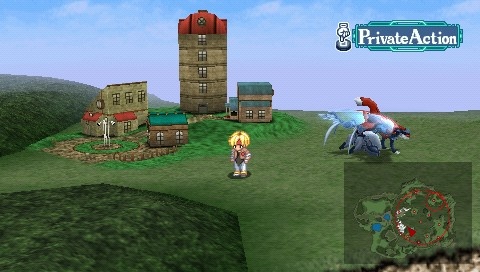
Private Actions returned again but I made little use of them.
The sci-fi elements on display were more pronounced however, with the final third taking place on another, further advanced planet. Energy Nede as it was called had an interesting backstory and was home to the Ten Wise Men. This group served as the eventual antagonistic force and they are one of the most memorable I’ve seen in a JRPG. They weren’t particularly fleshed out, but each one was unique and the progression in battling them made the conclusion an event. A few in particular were downright dastardly and evoked major tantrums in me. When they were felled, it was a satisfying event and ultimately everything ended on a cheerful note.
Battles and exploration were identical to First Departure, down to the UI. These remakes were developed at the same time and accordingly, it was all very familiar to me. I still relied upon spamming the basic attack and this continued to be a decent strategy. I will say there were more enemies that required me to flank and others that I had to earnestly avoid attacks, so the battles were a little less monotonous than I’d previously experienced. The skill system returned too and I, again, really enjoyed spending the accrued skill points increasing individual character’s stats and skills. It was an addictive facet that that had a noticeable impact on my party’s performance in battle, making it all the more incentivizing.
There were attractions and other diversions that I also didn’t invest myself in.
Visually, I found this game very appealing. It was originally made during the era of prerendered backgrounds and they were left intact for this remake. Games aren’t often made with this style of prerendered backgrounds anymore as the horsepower in our consoles and computers no longer calls for it. The buildings and towns were constructed using this graphical style and they look dated, which sounds offensive; I really liked them so I would say they looked… nostalgic. Because this style is still new to me, I was able to give some things a pass, like the poor scaling.
Some backgrounds were portrayed with such depth, that as I navigated Claude he would continue to shrink until I could barely make him out. Frequently, this made locating objects to interact with a bit of a chore. Part of the blame lies with the viewing area of the PSP’s screen. This was a console game originally so naturally it was meant to be played on a larger viewing receptacle. It wasn’t until I plugged my PSP into the TV and blew the image up that the visuals really looked right. The game was entirely playable on the PSP, and I usually prefer my RPGs in this form (apt for bedtime sessions), but the game’s roots begged for it to be played on the TV.
Those prerendered backgrounds were begging to be seen on a TV!
Star Ocean: Second Evolution was a more enjoyable game than its predecessor. The story was largely forgettable (what even happened in the middle, I couldn’t tell you) but it did have a larger concentration of sci-fi elements. As was the case with First Departure, it was when the narrative placed the characters in a futuristic setting that my attention was grabbed (especially when the Ten Wise Men were in play). But, it still felt like a fantasy JRPG wrapped in a sci-fi shell. The core gameplay mechanics– battling and adventuring – were identical to the previous game; they still remained fun after another twenty hours due to the additional challenge breaking up the monotony. And graphically the game was presented in a way that felt fresh to me, despite the dated stylings. It’s the best Star Ocean I’ve played to date, but much of it was largely forgettable and perhaps not worth seeking out. A better future was found, but here’s hoping for an even brighter one.
When it comes to an established franchise, I find it hard to experience it in any other way than completely engrossing myself. Whether it’s soaking up each entry in a role-playing series, or binge-watching a movie franchise, I like to get the whole story from start to finish. So with the recent announcement of the fifth Star Ocean game, subtitled Integrity and Faithlessness, I’ve found myself visiting the series for the first time, and from the beginning. There’ve been plenty of opportunities for me to check the series out over the years, and I’ve owned entries for years without touching them. But, much like the dual announcements of new Guitar Hero and Rock Band releases reinvigorating my desire to play earlier entries in those series’, this one did it to the nth degree.
Battles took place in fully roamable arenas – an evolution of Tales of Phantasia.
My first consciousness of the Star Ocean series occurred around the release of Tales of Symphonia. That seminal JRPG was one of the few on the GameCube and one of my favorites bar none. I turned to GameFAQs throughout that playthrough and the author of one FAQ in particular suggested Star Ocean: Till the End of Time so heartily, that I still remember that fact to this day. Needless to say I never checked it out (excluding a multiplayer match or two for the inaugural Game-a-Thon). Flash forward and I now own all but the most recent entry: The Last Hope. So, what better place to start than the first game?
Or truly, a remake of the first game as the western release lagged behind its Japanese debut. Star Ocean was originally released on July 19, 1996 for the Super Famicom. It didn’t make it to Western shores until the PlayStation Portable remake; First Departure was released in North America on October 21, 2008. Developed by tri-Ace, the game was the product of the studio’s collective experience making Tales of Phantasia and their love of Star Trek. It’s an action-RPG whose core elements stay true to likes of Dragon Quest and Final Fantasy, but the battle system is quasi-real-time and the setting has more in common with Phantasy Star. The PSP remake appears to remain very true to the original, and with the exception of a few items, I could imagine this game being a direct port.
There was an omnipresent feeling of the future, even while on Roak.
One of the elements that excited me the most in thinking about this series was the sci-fi setting. The ability for a lengthy RPG to fill out a world with backstory, characters, and places is a hallmark of the genre, and when that ability is buoyed by a sci-fi motif, well, let’s just say I’ve always been more interested in the future than the past. So I was disappointed when the majority of this game revolved around a fantasy setting. This was explained narratively in a way keeping true to its sci-fi background, and perhaps even by the constraints of the hardware or by the studio’s rookie nature.
Granted, this was all wrapped around the context of a sci-fi storyline and it did have its moments. The main protagonists hail from an undeveloped planet – one that the Federation (exactly what you’d think) has intentionally avoided until the inhabitants have reached their space age. So when the group is exposed to the Federation initially, there’s a lot of interesting story building that takes place. And again at the end, when the answers to the questions that have been posed throughout the game are being revealed; the sci-fi elements really sealed the deal. Plus, there’s time travel and that’s super sci-fi.
Most everything else is standard fare for the genre. I took the group from town to dungeon to town in search of this or that or whatever would progress the story. The combat system is an evolution of the real-time one pioneered in Tales of Phantasia. Instead of taking place on a 2D plane however, I controlled one of the party member’s in a 3D arena. There wasn’t a lot to fights other than mashing the attack button and maybe triggering a special attack every now and then. I was content to button mash and the lack of difficulty allowed me to breeze through the game.
An air of replayability was present as not all party members could be accessed in one playthrough.
I feel it was necessary for me to play this game, although I wouldn’t recommend it to others if they didn’t share my tendencies. It wasn’t a bad game, it just wasn’t that interesting. The settings offered an interesting clash, but this was mostly a fantasy game wrapped around the veneer of a sci-fi game. I found little to dislike about the combat system and could enjoy the monotonous task of mashing a button until a foe was dead, but I can’t praise it either. At roughly fifteen hours it’s the shortest JRPG I’ve played, but lengthy enough to tell a cohesive tale. Here’s hoping for a bright future.
Perhaps the greatest love letter to the Final Fantasy series came from within the walls of Square Enix itself. Featuring the protagonists and antagonists of the first ten games, this title brought them together in a universe-melding fashion. Two warring gods summon these individuals to do their bidding, which plays out in a cross between the fighting and RPG genres. I’ve yet to play it myself, but I’ve heard tell of Tridrakious spending upwards of 100 hours with it, so the game has to have considerable depth. Another game I’ve got to get around to. Too bad it lacks much content from Final Fantasy XII though.
Dissidia Final Fantasy was originally released for the PlayStation Portable in Japan on December 18, 2008, in North America nearly a full year later on August 25, 2009, and another month later in Europe – September 4, 2009. It was developed and published by Square Enix. I picked it up from All Your Base in Broken Arrow, not too long after the shop had moved into PJ Gamers.
When you have a video game collection like mine, it can be hard to play all of the games. This is especially true when additions are made on an almost weekly basis. Still, I appreciatenearlyevery game I’ve accumulated for this reason or that. In the hopes of improving my writing through continuous effort and promoting ongoing learning of these games, I’m going to compose brief, descriptive articles.
I want to say I purchased this game this year, although it may have been late 2013. My PSP collection has seriously expanded as GameStop shifted towards discontinuing the platform in the majority of their stores. Anyway, being a fan of JRPGs I’ve always been interested in this series but never took the plunge. I knew these games were remakes from a much older line of games, but reading about the series is a good refresher on just how many games remained exclusive to Japan in the late 1980s/early 1990s. This is actually the fifth game in the series, and the third in a trilogy. I haven’t played it and while I’d like to, I can’t say when I will.
The Legend of Heroes III: Song of the Ocean was originally developed and published by Nihon Falcom and released for the PC on December 9, 1999, exclusively in Japan. It finally reached North America as a PSP remake. This version was developed by Microvision and published by Namco Bandai Games on January 23, 2007.
As I browsed GameFAQs, searching for these images, a revelation occurred to me. Final Fantasy IV is probably the most re-released game in the long-running series. That’s a fitting fate for it too. It was perhaps the major title to usher in the “golden age” of Japanese role-playing games. At the very least, it was the first game in the series that hinted at the forward momentum Square would have over the next decade-and-a-half with the genre. So, why don’t you join me as I explore the covers Square used to sell the game over the years.
A cutesy move away from the previous games’ covers.
The first thing I noticed when looking at the original box art Square used for FFIV is the lack of emphasis placed on Yoshitaka Amano’s artwork. The previous three games featured his renderings of warriors and princesses prominently. This go around though, you’d think he was relegated to the logo only. This wasn’t the case though; Square simply chose to highlight a different aspect of the character designs – the super deformed! It’s cutesy for sure and plasters some common job classes upfront, and I guess I like that they took a different route with it. Oh, and there’s Kain Highwind in Amano’s logo.
Objects as letters! Not as bad as numbers as letters.
When they released it in America for the SNES a year later though, the American branch didn’t even try. It’s simple and it always catches my eye when I scour local game shops for good deals. Maybe it’s not so bad; it does catch my eye after all. They really had to pitch it to us though, didn’t they? They’ve got bullet points on the front of the box! It was released over here as Final Fantasy II since the second and third titles weren’t. This prevented much confusion. And releasing a dumbed-down version prevented much difficulty.
Back to Yoshitaka Amano.
The game was first rereleased for the PlayStation in 1997. The Japanese box art sees a return to the styling’s of Amano. Cecil Harvey and Golbez are prominently featured, although honestly, it’s hard for me to distinguish the rest of the imagery, and even if that really is Golbez and not Kain. Regardless, Kain takes his place in the logo. Cecil definitely fronted a hair metal band before being cast for FFIV. The PlayStation version was released in America too, circa 2001. It was bundled with Chrono Trigger and released as Final Fantasy Chronicles. There’s not much else to mention about the box art.
Bandai? You mean the company that collaborated on the Apple Bandai Pippin?
Little known to many Western gamers, Bandai had a fortuitous deal with Square to rerelease Final Fantasy titles for their WonderSwan and WonderSwan Color. FFIV was released for the WSC in 2002. A decadent airship is featured in the background that was no doubt crafted by the illustrious Cid Pollendina.
Simple.
FFIV would next see release on a Nintendo platform again – the Game Boy Advance. It was released as Final Fantasy IV Advance in Japan and America in December 2005, and six months later in Europe. The Japanese box art is simple. Gray silhouettes of Cecil and Kain flank the logo. Meanwhile the American and European release is much more colorful. These versions feature Cecil and Kain, as well as Rosa Farrell for the first time. The box art used for these regions hints at the love triangle between the cast. This is definitely Amano refining the “wispy lines” he’s known for.
Less simple, but I prefer it!
A few years later, the game saw a full-scale remake into 3D. Originally released for the Nintendo DS in Japan in December 2007, it was released in the back-half of 2008 in America and Europe. It has since been released for mobile devices running iOS and Android systems as well, but those platforms don’t really have boxed games… Japan received another Amano box art, featuring a larger portion of the cast, including the Lunar Whale. Here in America, we received an ominous black box, which formed a holographic Golbez. Europeans received the same essentially. The only difference was the color palette.
The DS covers.
Finally, FFIV was bundled together with Final Fantasy IV: The After Years and an interlude bridging the two titles as Final Fantasy IV: The Complete Collection. This was released for the PlayStation Portable in 2011 and was the version I played. I think Japan and Europe got the better box art with this release. A large portion of the cast is done in emotive poses, painted in a watercolor style very reminiscent of Amano’s work on the original three games in the series. America on the other hand received gray silhouettes of Cecil and Kain against a white background. This version was very reminiscent of the Japanese release of Final Fantasy IV Advance.
The PSP covers.
With a brand as strong as Final Fantasy, the box art doesn’t have to sell the game. This might explain why Square has felt the liberty to rerelease Final Fantasy IV with a multitude of different covers. With much variety for this one game, it’s hard to pick a single favorite. I really like the Japanese and European release of Final Fantasy IV: The Complete Collection. It’s probably the easy favorite. All of Amano’s artwork is awe-inspiring personally. Heck, the Super Famicom release is cool too, in a differentiated cutesy way. I’ll go with my easy favorite though – the Japanese and European releases of The Complete Collection.
Bundling FFIV, The After Years, and a new interlude, this version has the most content of any FFIV release.
Having played through Final Fantasy III a few years back, and now having completed Final Fantasy IV, I can see a noticeable divergence in the series. This was no doubt brought about because of a new console generation. FFIII was originally released in 1990 for the NES (or Famicom, rather as it wasn’t released in the west until the 2006 DS remake) while FFIV was released in 1991 for the Super Famicom and SNES. Despite only being released a year apart, comparatively, the narrative and gameplay are worlds more complex in FFIV.
Beginning in the kingdom of Baron, Final Fantasy IV centers on Cecil Harvey. A devout and highly ranked member of his king’s military, Cecil follows the orders of his king, to the point of attacking a neighboring city to obtain their crystal – an important and mystical object. Upon questioning the king’s actions, Cecil is stripped of his rank and assigned the task of delivering a package to another neighboring village. The package winds up being a ruse, containing monsters which level the village. After these events, Cecil begins his quest to discover the actions of his king. Ultimately though, it’s a quest to discover Cecil’s identity and rid himself of the darkness in his heart.
Dungeon crawling is a major aspect, per usual.
Although there is a clear and singular protagonist in Cecil, Final Fantasy IV features nearly a dozen named protagonists who shift in and out of Cecil’s party as major events happen. Also hailing from the kingdom of Baron are Kain Highwind and Rosa Farrell. Kain is fellow soldier, rival, and friend. Rosa is a friend and love interest to both. Cecil and Rosa are clearly meant to be together and Kain deals with his jealousy throughout the course of the game, at points, succumbing to the darkness in his heart. Cid Pollendina is another Baron native and is the creator of airships and services the king’s vast fleets. He’s a rambunctious man who lends more than a hand.
There’s also Rydia, a young summoner and sole survivor of the village Cecil inadvertently leveled. She harbors hatred for Cecil early on, but eventually realizes he wasn’t to blame. Tellah, a powerful sage, joins Cecil and his party as he searches for the prince of Damcyan. Edward, the bard prince, was engaged with Tellah’s daughter before she perished. Tellah had felt Edward was to blame until he learned of the couple’s love for each other. A strong monk, Yang, joins the fight after the antagonist Golbez brings the fight to his hometown. The twin mages, Palom and Porom, bring lighthearted humor to the narrative. While only a few years old, they’re very knowledgeable about their craft. Two late-game additions are Edge and Fusoya. Edge is a cocky prince looking for revenge against Golbez. Fusoya is a lunarian – a resident of the moon.
The party was usually stacked with five protagonists.
The dialogue in the game is very limited compared to modern video games. That being said, the characters’ personalities do shine through and the sheer number of them kept the game fresh. As this was my first time to play Final Fantasy IV, I cherished coming upon dialogue and events that I’ve heard described as classic. Experiencing and understanding the context of the “you spoony bard” line was a favorite of mine. The major events were often too, helping to captivate me. Especially the final hours of the game which saw Cecil and the party fly to the moon! This was something else after thirty hours of traveling on Earth, never expecting anything different.
Speaking of memorable and important events, Final Fantasy IV is the game that introduced the active time battle system, or ATB system as the game refers to it. Allies and enemies continue to take turns but time continued to flow while I chose a character’s action. This could be switched to pause time while navigating menus, but I chose to experience the battle system with time continuously flowing. In the version that I played (Final Fantasy IV: The Complete Collection for the PSP) each character had a meter representing their turn. The meter filled at a rate dependent upon the speed of the character in question. For instance, someone dainty like Rydia should be able to a get three actions in for two of Cecil’s.
Lacking the job system introduced in Final Fantasy III, all the characters in Final Fantasy IV are specialized. I wasn’t troubled by not having that customization over the protagonists. Due to the brisk narrative, characters were shifting in and out of the party frequently. Therefore, I never got bored of the composition of the party. Sections were never too tough either. The game was balanced in such a way that I was never able to blame any failings on me losing a powerful character or a healer. Yet, I did have to do plenty of endgame level grinding to conquer the final boss – an hour or two at least.
Cid is a rambunctious old man.
I was honestly blown away by how much I was captivated by Final Fantasy IV. The dialogue was relatively bare-bones, and reading up on the development proved some of my theories on content being cut, but I still was captivated. The narrative moved briskly and thanks to the always changing party composition, it was hard for me to get bored of the random battles. I played the PSP version and I can look forward to playing The After Years at some point as the games are bundled together. My only gripe with this version is the inability to play with the original graphics. I would’ve appreciated the ability to switch between the redone visuals and the original sprites as I was able to do with the soundtrack in this version. For being twenty-plus years old, I still found the game to be captivating. Much more so than the previous game in the series. What a difference a year can make!
I really like video game boxes. Barring any previous knowledge about a specific game, they can make or break an impression. Having edited a lot of information on Giant Bomb in the past and thanks to my general encyclopedic tendencies to research video games, I enjoy seeking out the different covers that were used for video games in regions other than the United States. The Resistance series has had many variations for the primary trilogy, and even for the two handheld games, that I want to post about.
This is a game you can judge by its cover.
The series’ initial release was a fairly standard first-person shooter and it’s box art isn’t eye-catching. It’s grayish palette is boring, and then you notice that isn’t a human skull. One thing that I really like about the series’ logos, is the use of landmarks related to the game’s setting. In this incarnation, Big Ben (officially known as Elizabeth Tower) defines the A. With the exception of various rating labels, this box art was used in all regions.
Grrr, me gruff man with weapon on video game box.
Resistance 2 saw Insomniac Games adopting the “scale and Hale” approach, and it most definitely traded on a larger scale and included more depth to Nathan Hale than Fall of Man. The box art is fairly representative of this although some might say it’s a little generic thanks to the image of Nathan brandishing a gun. The background conveys a lot on the flip side. For this release, the Golden Gate Bridge defines the A.
Insomniac released a few alternate covers through the PlayStation Blog, this was the first one.
A few alternate covers were released through the PlayStation Blog for fans to print off and replace the original Resistance 2 cover if they desired. The first one didn’t alter much. It features a zoomed in Nathan, perhaps better conveying his Chimeran traits visible by his eyes.
This was the second alternate cover released through the PlayStation Blog.
This is the second alternate cover released through the PlayStation Blog and I really like it! I think it’s more eye-catching than the cover used and foreshadows the duality in Nathan’s half-human, half-Chimeran traits. This is also true for America, before and after the Chimeran invasion.
Japan’s box art for Resistance 2 removed Nathan and piled on the Chimera.
Finally, Japan received a different box art for their release of the game.This one conveys a little more of the futile nature of the human-Chimeran conflict that I surmised present in the game’s narrative.
Olly Moss’ artwork is fantastic and it’s too cool that he was commissioned for this game.
And with Resistance 3, Insomniac and Sony went a completely different direction. Without a doubt, it’s more “artsy” than any other Resistance cover. A visit to Olly Moss’ website proves he has a definitive style that harkens back to periods past, and his design was somehow fitting for the final game in the trilogy. Defining the A this time is the Statue of Liberty.
For the trilogy compilation, Olly’s artwork was utilized again.
There have been two compilations of the series thus far. A dual pack release that bundled the first and second games together and an actual compilation that featured all three games. The North American box art isn’t really noteworthy. it features the basis of Fall of Man’s box art with some stickers stating what it is. This cover however was utilized for Europe and Australia and is much, much cooler.
The two differing box arts for the PSP game.
The first spin-off for the series was Resistance: Retribution for the PlayStation Portable. From most accounts, it’s a stellar game that isn’t as hindered by the PSP’s lack of a second analog stick. I haven’t played it myself, although I’m looking forward to it. Both covers feature the Eiffel Tower prominently. The left-hand box art was used in America and Japan and is similar to the second game’s while the right-hand one was used in Europe and Australia and reminds me of Japan’s cover for the second game. With this title, the Eiffel Tower defines the A.
Wow Japan, very cool!
The most recent, and likely final, game in the series is Resistance: Burning Skies for the PlayStation Vita. It was generally received negatively, but I’m still moderately interested in it. The North American and European cover implies a violent end for the Chimera in question while also highlighting the occupation of the protagonist. The Japanese box art is oddly colorful and I’m really drawn to it. Defining the A for the final time is Tom Riley, the game’s firefighter star.
The series has had a fair amount of diversity in the various covers but one thing always remained constant: Chimera. Dead or alive, they were always present.
I’m going to approach this article a little differently than I usually do. The above is a link to a Joystiq article by Kat Bailey wherein she discusses her love for Valkyrie Profile. Coincidentally, I had quit playing Valkyrie Profile: Lenneth, the PSP remake, only a few days before she posted this article. After spending about thirteen hours with the game, I decided it wasn’t for me. Today, I’m going to riff off her article and try to get the core of what exactly it was about this game that didn’t appeal to me.
What Kat really dives into first is the combat system. She describes it as it is – “fun, fast, and interesting to look at” and I agree, but more so when she considers it serviceable. She doesn’t linger on it long and neither does the game. It’s a combat system that lacks much depth. In my time with the game I kept waiting for combat to expand and it never really did.
Towards the end of my tryst with the game, I began to see promise in the form of new skills. These augmented my roster of characters in many ways, but why didn’t I see more of these in the first third of the game? It would’ve given me more desire to customize my crew and maybe look forward to battles. There were many passive skills that increased stats with many more that seemed to only impact my ranking for sending characters to Asgard – a concept that’s barely discussed. The combat and support skills that began appearing after a dozen hours, I wish, would’ve appeared sooner.
Each face button represented a character in battle.
As she continues, Kat begins discussing the role of the plot in the game and the dueling narratives. In regards to the overall story of Ragnarok, it’s very straightforward. Lenneth is on a quest to recruit einherjar to defend Asgard in the impending end of days. The subplots of Lenneth’s past and deeper truths of other important concepts in the game are present, and intentionally obtuse. Kat describes this subplot information as “bad game design” as it’s there for the player to experience but the main narrative misleads the player. I highly agree and would add that the game really doesn’t explain much about the subplot.
I do like the concept of the game misleading the player to believe an untruth, but I find it curious that these subplots are present, but there isn’t anyone advocating these paths to the player. I guess the player is expected to stumble upon these encounters, which isn’t guaranteed because of the game’s structure. Granted, in my time spent I only had a few encounters that were related, but they explained nothing! I suppose that’s to be expected in the first third of the game – questions, not answers – but, honestly, barely anything is explained in this game.
This sounds like it could foreshadow a solution to a later puzzle.
Perhaps, the biggest detractor to Valkyrie Profile was its lack of explanations in regards to pretty much anything be it a gameplay mechanic or story beat. That being said, I was dissatisfied with the lack of attention devoted to the, admittedly, large roster of characters. Besides the initial recruitment cutscene, there was little attention paid to them again. I also felt limited by the game’s structure. Divided into chapters and further into periods, entering towns and dungeons became a commodity as I did cost benefit analysis to determine whether or not to take a certain action. After a few hours though, I didn’t really want to explore because towns offered me nothing and dungeons were hardly any better. The combat was unimpressive in the first third of the game as well. So ultimately it was a combination of EVERYTHING that left me ambivalent towards seeing how Ragnarok played out.
Share this:
Twitter
Facebook
Tumblr
Like this:
LikeLoading...
The internet's source for Mansion of Hidden Souls.
![Resistance: Retribution [PlayStation Portable] – Review](https://mybrainongames.files.wordpress.com/2021/07/resistance-retribution-playstation-portable-north-american-box-art.jpg?w=672&h=372&crop=1)

![Kurulin Fusion [PlayStation Portable] – Review](https://mybrainongames.files.wordpress.com/2019/05/kurulin-fusion-playstation-portable.jpg?w=672&h=372&crop=1)

![Star Ocean: Second Evolution [PlayStation Portable] – Review](https://mybrainongames.files.wordpress.com/2015/09/star-ocean-second-evolution.jpg?w=672&h=372&crop=1)




![Star Ocean: First Departure [PlayStation Portable] – Review](https://mybrainongames.files.wordpress.com/2015/05/star-ocean-first-departure.jpg?w=672&h=372&crop=1)


![Random Game #44 – Dissidia Final Fantasy [PlayStation Portable]](https://mybrainongames.files.wordpress.com/2015/03/dissidia-final-fantasy.jpg?w=672&h=372&crop=1)

![Random Game #27 – The Legend of Heroes III: Song of the Ocean [PlayStation Portable]](https://mybrainongames.files.wordpress.com/2014/12/the-legend-of-heroes-iii-song-of-the-ocean.jpg?w=672&h=372&crop=1)


 My Brain on Games