Time Clickers is an incremental game, a newish term for a genre that’s perhaps better known to host idle and clicker games, that is, games like Cookie Clicker, Progress Quest, and Candy Box. These games generally have no end objective and offer the player little avenue for input, but are wildly addictive. I’d like to think these games are best experienced passively with a routine check-in, but that hasn’t stopped me from spending elongated sessions with them or alt-tabbing to one of them every 30 seconds. The endless grind for improved effectiveness results in short-term satisfaction and long-term emptiness that usually sees me dropping off.
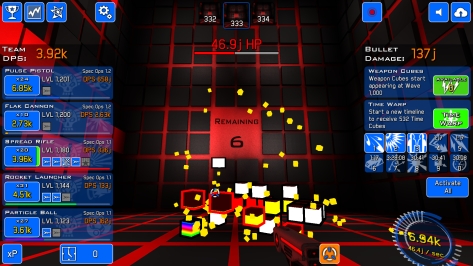
The viewpoint is stationary although the cubes are visually interesting and the particle effects are immense.
The basic, never-ending objective of Time Clickers is to destroy waves of assembled cubes. Doing so generates cubes to spend towards weapons, abilities, and upgrades. It starts off innocuously enough with a measly handgun but after a minute, the player has accumulated enough cubes to hire some additional weapons. Altogether, the player can eventually hire five other weapons that dropped out of Unreal Tournament, not to mention the ability to unlock idle mode for the handgun so they don’t have to actively destroy cubes themselves; a slew of abilities are also available for purchase. At this point, progress is based around increasing the DPS, thereby increasing the revenue intake. Each of the weapons can be endlessly upgraded and for the first run or two, that was my singular motivation.
The time aspect of the game comes into play in the form of Time Warps (as well as spending time “playing” the game, I suppose). After wave 100, a new type of cube begins appearing, one which can be spent on a variety of upgrades in the game’s skill trees. To spend these however, one needs to Time Warp back to wave 1. With each successive Time Warp, waves go by quicker, upgrades come faster, and Time Cubes, this new form of currency, are accumulated well, more rapidly. The “wall” one hits where enemies are too tough keeps extending into ever higher waves and progression somewhat resembles a roguelike in this way. This currency and these skill trees are now motivating me although I can still look forward to Weapon Cubes which begin appearing after wave 1,000. I haven’t gotten that far but the related unlockables don’t seem as clutch as the ones I’m dealing with now.
Speaking of immense, the skill trees shown here will take a long time to complete, if they get completed at all.
At this point, after about two weeks with the game, I don’t see a window for when I’ll be satisfied or done with it. I’d like to treat this game more as a timewaster, but I routinely find myself glued to it when there’s no time to waste. It’s a very addictive game and indicative of what so many of its contemporaries do so well: take a barebones approach to progression and ratchet up the feedback and reward loop. Time Clickers in particular is a prime example of this and with mobile and Steam versions that support a unified cloud-save system plus leaderboards it’s an easy sell for a free game. Shoot, the mobile version incentivized watching ads well enough that I did nearly every opportunity they came along! It’s inevitable that my focus will eventually turn away from Time Clickers, but for the time being I’ll keep alt-tabbing and wasting my lunch hour away with it.
I’m a little late to the party on this one but I finally beat Portal. It’s an ingenious puzzle game that doesn’t overstay its welcome. In fact, I was befuddled that it was over as quickly as it was. Since I’d heard so much revelry and acclaim for it and witnessed the cultural impact it’d had in the gaming space I just figured there’d be more of it. What was there engrossed me though. The increasingly complex puzzles were mentally stimulating and the enigmatic GlaDOS’ darkly humorous speech had me chuckling well into the few hour experience.
Portal was a puzzle game with an ingenious mechanic.
The game is built around the portal gun which allows users to shoot portals on flat surfaces. The portals are connected and can be easily referenced as an entry and exit. At its most basic use, I could place a portal on ground level, shoot the other portal on a wall above a higher level and use the portal to reach higher ground without using a ladder. Through the game’s nineteen test chambers, the quandaries were rarely this simplistic. The way I had to manipulate the portals was fascinating and thought-provoking. Dropping into one and utilizing the momentum to fling myself across the room was always amazing.
As I mentioned the game has nineteen test chambers that lock progression behind increasingly difficult puzzles. There are no other lifeforms present although observation windows and empty chairs indicate there were at some point. Guiding the player through these chambers is GlaDOS, a disembodied mechanical female voice. Her statements are delivered with a sense of dry, deadpan seriousness that are made clear when her motivations are discovered. Things are not what they seem and while there is no narrative, there’s an abundance of environmental storytelling that allows the player to fill in the gaps themselves. It all culminates in an appropriate ending sequence that was riddled with GlaDOS’ hilarious interruptions.
Infinite portal loops were easy to do and fun to witness.
For most I’ve probably revealed nothing new about this game. Portal sent shockwaves through the gaming culture when it arrived in 2007 as a part of The Orange Box and is still highly regarded and oft-discussed. I’m glad to have finally experienced it and would recommend it to those who have yet to do so. The game was brief but left me both fulfilled and wanting, in a good way. I can only imagine the impact the modding community had on this title and I’m excited to see the crazy stuff they came up with.
It’s no surprise that my playthrough of Her Story was unique. After all, it’s the type of game that walks the tightrope between video games and more generally, an interactive experience. In my case, it was a cooperative playthrough with a friend. We had returned from a local independent theatre after watching Why Don’t You Play in Hell?, a riotous Japanese language film. (Wowzidukes! This article is going to earn me so much hipster cred!) I rarely play PC games so this was somewhat unusual but I’d heard much of it through social media word of mouth and gaming sites last week, plus it was only five bucks. It was a good plunge to take too, as the game provided a fun cooperative experience.
The presentation of the game was top-notch. Notice the light glare on the CRT monitor!
Her Story revolves around a series of interviews that the police conducted with a British woman whose husband was found dead in 1994. These were filmed at the time but for whatever reason, are no longer able to view in their entirety. Instead the player can interact with a police computer and search a database that retrieves clips based on search terms or phrases. The corresponding video clips seemed to average about thirty seconds in length. It’s unclear what ever became of the woman and the police’s investigation, but it’s implied that’s what the player’s character is after and serves as motivation for the player.
The way the game is presented is nostalgic. The police computer that the player interacts with appears to be running a dated version of Windows on an equally ancient CRT monitor. When a search is conducted, it takes a second for the computer to produce the results and the work it performs is audible. The player isn’t locked to a single program however as there are a few .txt documents and a “rubbish bin” with a minigame on the desktop. Crucially, all of the video footage is rendered as full-motion video. FMV tends to be a divisive issue in terms of video games, but the execution of it here is perhaps the best example I’ve seen, even beating out the Mad Dog McCree trilogy!
The police computer in question, with the woman in question.
I’ll save any sort of plot spoilers or ruminations for another article. The way everything played out led to a lot of discussion between my friend and I. After our initial playthrough, there were two obvious ways everything could’ve happened, but I think we’re still undecided on the truth. I’m looking forward to replaying it with him so we can take detailed notes and reach a verdict. That in itself is hardy praise for Her Story. I feel confident enough with my theory on what happened that I’d be satisfied enough to move on, but I want to fire it up again, and definitely will this weekend. It’s well worth a look.
When you have a video game collection like mine, it can be hard to play all of the games. This is especially true when additions are made on an almost weekly basis. Still, I appreciate nearly every game I’ve accumulated for this reason or that. In the hopes of improving my writing through continuous effort and promoting ongoing learning of these games, I’m going to compose brief, descriptive articles.
This is an article about Surgeon Simulator 2013. Here’s the deal though, I haven’t actually played it… yet. I’ll get around to it someday – trust me. I, no doubt, acquired it as a part of some Humble Bundle, and honestly didn’t think too much of it until now. I hadn’t heard of it prior to my acquisition and summarily forgot about it afterwards. Having just watched a few videos of the game on Steam though, I’m surprised! It’s not a serious take on surgery, but instead, a “darkly humorous” take on the practice. It appears to have a control scheme similar to Octodad, the goals of Trauma Center, and the parameters of Operation. It looks comical and it’s on my radar now.
Surgeon Simulator 2013 is actually the follow-up to a prototype of sorts that was developed in 48 hours, presumably during a game jam. This title was developed with a little more time – 48 days. The individuals responsible were Tom Jackson, Jack Good, Luke Williams, and James Broadley; otherwise known as Bossa Studios. This game was originally released for PC and Mac on April 19, 2013, and has since seen releases on PlayStation 4, iOS, and Android.
The next game my friend and I transitioned to was Greywater – an isometric role-playing game in the vein of Diablo. If Project Land Mineded was the most technologically proficient game I played, then Greywater had the strongest art direction and implementation. The steampunk influences were readily apparent at first glance and the art style was complimented by a 19th century backdrop of a highly polluted city – hence the name, Greywater. It also seemed like there was a lot of story and character development already present in the playable demo, more than any other game I played at the show.
That said, I actually didn’t play much of the game as I didn’t gel with the control scheme. I might not be recalling correctly, but I believe movement and attacks were done via the keyboard while menu navigation was with the mouse. I would’ve preferred most everything but movement be done with the mouse. I also didn’t get a good sense of feedback when attacking enemies. I couldn’t tell if I was damaging them or missing completely. I wish I’d played more of Greywater in hindsight as Team Sweepy placed second in the game showcase and won the gallery show. Congrats to them!
If you wanna follow their progress, you can do so via their Tumblr or Twitter.
Watching Phantasy Star Online Episode I & II’s attract mode and listening to its main theme is haunting as it reminds me just how much of an impact the game has had on me. When I began playing the GameCube rerelease of the classic Dreamcast game, I was just developing a burgeoning appreciation for video games. It was a form of escapism – it transported me into a spectacular science-fiction setting where I’d spend hours searching for better gear, rare loot, and just taking in the sights. Its action-based combat and role-playing foundations were not only appealing to me, but what I still consider to be one of the pinnacle’s of video game design. I’ll routinely return to it and I can easily get sucked back in for hours. PSO’s story was light, but I felt as though I truly was a pioneer uncovering the mysteries of a brave new world.
Sega has made plenty of sequels to PSO since its original Japanese release of late 2000, but none of them properly advanced, or even recaptured what made PSO so great. The most notable among them, 2006’s Phantasy Star Universe introduced an honest-to-goodness attempt at a narrative which, in my eyes, fell flat thanks to my low tolerance for the adolescent anime that inspired it. Yet the most incriminating blow against PSU was its decreased emphasis on dungeon-crawling and looting. However, it seems Sega’s losing streak is about to end with the release of Phantasy Star Online 2.
After entering open beta on June 21, 2012, I jumped at the chance to check out PSO2 for myself. Unfortunately for me, the beta is hard to understand because it’s completely in Japanese. Luckily, there are plenty of English-speakers who are rallying together to translate the beta and enjoy it. I have to give massive thanks to bumped.org for assembling many great guides ranging from how to download the beta to complex menu navigation.
A party taking on a big baddie.
Although my time with PSO2 has been brief and I’m usually in a state of confusion, I’ve been able to gleam many things about it thanks to my experience with PSO. Firstly, the game looks amazing. Character designs retain the non-flamboyant sci-fi anime style from PSO while, unfortunately, still housing some over-the-top designs in the vein of those from PSU. The first playable stage, the forest environment (the only I’ve played in) harkens back to PSO’s first stages while marking massive technologic advances since 2000. PSO2 looks phenomenal and it seems like it scales well, accommodating laptops up to high-end gaming PCs.
Combat is still based around rhythmically forming combos. Attacks are sequenced together by timing button presses, generally up to three times. Previously, animation preferences made combat less than fluid, although now it seems sets of three-hit combos can be started much quicker after one ends giving combat a better flow. Enemies can be locked onto ensuring accuracy with specific weapons like guns, but a new camera angle presents the game more like a third-person shooter which may be more appealing to some folks. Also brand new is a jump button which can be used to navigate environments better and reach weak spots on enemies. Loot is indeed present but I can’t provide any detail thanks to the language barrier.
The third-person shooter mode actually makes sense in this series.
Players still pick from one of three classes; a decision revolving mostly around swords, guns, or magic. However, characters are no longer locked to a class, they can be changed whenever but the character has three levels – one for each class. Character customization is accounted for and it’s as deep as it has ever been.
Spaceships representing servers are the characters’ residences and here humankind thrives. Other players wander about as though they were in a virtual mall, which they are – shops are abound. Of course communication is a major aspect and plenty of players have mastered the art of picture chat. Alone or with a posse, missions can be tackled that, with an understanding of the language, would unravel the mysteries of the game, but as is just provide another obstacle to enjoying the game.
Phantasy Star Online 2 seems very promising to me. As someone who loved PSO, but not much else past that game, I appreciate that the developer’s have that game in their mind. I hope PSO2 is as eminently replayable as PSO was – complete with multiple difficulties, loads of loot, weapon grinding, and character progression. As of now, I can’t fully experience the open beta and understand all of the changes, but the fact that they aren’t straying too far from the original formula is satisfying enough to me. After all, I spent three hundred plus hours with PSO without ever going online.
This isn’t the Jamestown we learned about in school.
I’m relatively inexperienced with the PC scene, but thanks to the Humble Indie Bundles, I’ve been dipping my toes the water more often. With the fourth and fifth HIBs in my possession, I recently decided to jump into Jamestown: Legend of the Lost Colony. Developed and published by Final Form Games (a studio consisting primarily of just three dudes!) and released last year, it’s an homage to the shoot ‘em ups of the 16-bit era wrapped around an alternate-historical story.
It’s the early 1600s and thanks to unmentioned advancements in technology, the British have colonized Mars instead of North America. Unfortunately, a combined force of Spanish and Martian soldiers is causing trouble for the British settlers and it’s against this backdrop that a personal story is told involving many real life figures. The game is brief so there isn’t much in the way of narrative, but the interesting setting and alternate-historical story is a neat addition to a smooth game.
The bosses that capped off each stage were impressive.
As I mentioned, the developers of Jamestown must have some reverence for the shoot ‘em ups of the 16-bit era. The graphics appear as if they’re straight out of an arcade cabinet circa the early 1990s. Also, it was around this time that bullet bell shooters were beginning to arrive on the scene and Jamestown clearly fits into this subgenre.
Jamestown starts off simply but eventually cranks up the difficulty when hundreds of bullets are on the screen at any given moment. These types of shooters generally require catlike reflexes and lots of pattern memorization but thankfully, Jamestown isn’t too gnarly. I found it to be paced very well, subtly cranking up the difficulty as stages progressed until the final encounter which tested my skills in different ways.
The gameplay “hook” for Jamestown is a move called the Vaunt. After filling a gauge, I could Vaunt, at which point a shield would temporarily eradicate any nearby bullets. As long as I could keep the gauge full by collecting coins, I’d also have increased damage and a 2x points multiplier.
Although the game proper is brief (easily completed in one sitting), there are plenty of incentives to keep playing. With the story finished, it can be replayed in Farce Mode which exchanges the serious text in the cutscenes to something more whimsical. There’s also a second mode of challenges that have super specific goals. But my two most favorite aspects about Jamestown were the ability to play it using an Xbox 360 controller and the local multiplayer for up to four people.
Shit.
With an Xbox 360 controller in my hand and my laptop hooked up to my TV via HDMI, I was in hog heaven. Jamestown is a finely-tuned shoot ‘em up; blasting enemies, dodging bullets, and collecting coins were all intrinsically satisfying experiences and its lax difficulty (or tough depending on how hard you want it) meant that I could get involved in the game, without pulling my hair out. Jamestown: Legend of the Lost Colony is a fantastic game – kudos to Final Form Games.
In the aftermath of Double Fine’s outrageous success on Kickstarter, the service has received a lot of attention from smaller developers and the press. Since their achievement, other companies have turned to Kickstarter as a means of funding their projects and Wasteland 2 is the latest success story.
The original Wasteland was a post-apocalyptic role-playing game released for computers in 1988. Prior to reading about the similarly stupendous success of the Wasteland 2 Kickstarter, I had never even heard of the game. In the related marketing for Wasteland 2, Wasteland is billed as the original post-apocalyptic RPG, a precursor to the Fallout series of games. In fact, Wasteland served as an inspiration for Fallout.
It’s not necessarily the success of Wasteland 2’s Kickstarter that prompted me to write; although how Kickstarter, direct funding from consumers, and video games can interplay (catch the reference?) piques my interest, especially considering I’m studying business. No, instead it’s the following image.
There are multiple things about this image that I find enthralling. I think the setting is the biggest facet of my adoration. The post-apocalypse is theoretically an ugly place, especially in the wake of an atomic holocaust if that’s the cause. What I see in this image though is the overgrowth of plants; being in a city setting makes it all the more unusual and appealing to me. When I begin to think about exploring this place, I can’t stop imagining what I’d find, and what the rest of this city, and world for that matter, are like.
The lush, plant-ridden settings is a key factor in why I love Final Fantasy XII so much, and a big reason why I’m enjoying my time with Xenoblade Chronicles. Those games featured very open environments inducing exploration, and I wonder if Wasteland 2 will be the same.
I really like the scorpion mech too. Styling it after a scorpion, gives it such a menacing look. I wouldn’t want to come upon it as an enemy, that’s for sure. It’s easy to go down a rabbit hole thinking of the scorpion mech’s construction and what mechs are like in this time, and really, what the world is like too.
A colorful, vibrant, but not overly so, setting is something that immediately turns me onto a game and it’s why I might try Wasteland 2 simply upon seeing this image. I just wish I had helped fund it now.
Batman: Arkham City is the follow-up to one of 2009s most popular and critically acclaimed games: Batman: Arkham Asylum. The combat is nearly identical to Arkham Asylum’s while the environment is many times larger. Throw in a captivating story with a ton of post-game content, and I think 2011 is going to be a repeat of 2009.
Batman: Arkham City’s combat is mostly unchanged from Batman: Arkham Asylum. It revolves around Batman pummeling bad guys with his fists and gadgets and doing it exceptionally well. He leaps from goon to goon, even when they’re incredibly far apart and the blows he delivers are impactful, especially the final hit when dealing with a group of hoodlums. I didn’t make good use of every option available to Batman, but I really, really liked the melee combat. I’ve heard it called the best melee combat in video games and I’d have to agree.
The fights get tougher when different enemy types are introduced. There are a few larger than normal enemies that take a whooping and there are a few that require special tactics such as attacking from behind, but Batman’s biggest threat, aside from a few bosses, are enemies with guns. In a way, Arkham City has two modes of combat. The first is the all-out melee combat where I took on any comers, while the second revolved around stealth.
If I didn’t act stealthily around bad guys with guns and they noticed me, it was basically game over. Batman can take a walloping from run-of-the-mill bad guys, but guns shred him up. When I encountered a group of well equipped thugs, I took them out quietly, and this was as fun as tackling a large group. As I took more enemies out, they would freak out, giving me direct feedback on how I was doing. What I liked most about this sort of combat however was my forced reliance on my environment and gadgets. If I didn’t take these two aspects into consideration, thugs with guns would be much tougher.
Detective mode returns!
After the events of Arkham Asylum, Gotham City is still fed up with the villains that plague them. Through a curious chain of events, the most crime-ridden area of Gotham City is condemned and turned into Arkham City, a massive jail essentially. Dr. Hugo Strange is a key figure and as one might guess, up to something sinister.
Strange captures Bruce Wayne as he’s criticizing Arkham City and announcing his bid to run for mayor of Gotham City. Unfortunate for Strange, Batman is now inside Arkham City, but he’s not alone. Catwoman plays a large role in the game, but it’s strange how she is implemented. The ability to play as Catwoman is really a piece of downloadable content and included with any new copy of Batman: Arkham City. But everyone else will miss out unless they buy the DLC. Not infuriating, but whatever.
Her story is woven into the game at four points, and at natural breaks in Batman’s story. Her plot intertwines with Batman’s and I generally liked the break from Batman. She plays very similar to Batman, but she doesn’t have the same gadgets. She doesn’t have a lot of them either; only three compared to Batman’s dozen. Her fights were predominately just that, fights; I rarely took enemies out stealthily as her.
Batman and Catwoman meet many familiar and not so familiar villains from Batman lore. Batman has run-ins with a few major players like The Penguin and Mister Freeze, but The Joker is his main foe. What happens is very peculiar though. For most of the game, they are seeking the same thing and they operate as frenemies, but the way their relationship eventually plays out is intense.
I was really captivated by Arkham City’s story. Every time I’d finish a story thread, something interesting would happen and make me want to continue. Unlike a lot of games, I rarely wanted to stop playing it, and when I wasn’t busy with the story, I had a fairly large open world environment to explore.
By interrogating certain thugs, locations of Riddler items would be placed on my map.
Scattered about Arkham City were hundreds of riddles and trophies The Riddler left behind; literally hundreds, nearly five hundred in total. I almost feel like it’s too many, but then again, I’ve spent as much time with the game after I beat it as I did to beat it. Most of his items are trophies and these require clever uses of Batman’s gadgets. There are also riddles which require me to take a picture of something, but I had a hard time with these considering the large environment. His items would be tagged on the map after beating up certain thugs and this was very welcome.
When not going after Hugo Strange, The Joker, or The Riddler, I had a decent amount of side quests to tackle. These were mostly tasked to Batman by his enemies, which seemed odd. I mean Batman had incentives to undertake them, but if I simply told you Batman was assisting Bane without elaborating, you’d probably be confused. In the same vein, Batman never kills his enemies, which in some circumstances, is frustrating. I understand he doesn’t want to take a life, but locking someone up in a simple cage seems shortsighted.
Besides the standard game mode (in which I could fully explore Arkham City post-game and tidy things up as Batman or Catwoman) I could undertake the Riddler’s Revenge mode. This mode contained a lot of maps where I was tasked with beating up groups of thugs and getting ranked on how well I did, or taking a group of thugs out silently, and in a few specific ways. There is a lot of stuff to do in this game!
Tagging objectives and items on the map resulted in a Bat-Signal which was very helpful and just plain cool.
Batman: Arkham City is an improvement over Batman: Arkham Asylum. The combat system has changed little in two years, but it’s still so great. I really liked the story and was surprised by a few things that happened; I’ll definitely remember the ending. My biggest takeaway from Batman: Arkham City is the amount of content it contains. I’ve spent a lot of time with the game these past two weeks, and it’s one of the only games I’ve ever completed and then jumped right back into… for another dozen or so hours. Having strayed from many of this year’s new releases I can’t say with authority, but I believe Batman: Arkham City is one of the year’s best games. Batman: Arkham City was developed by London based Rocksteady Studios and published by Warner Bros. Interactive Entertainment for the Xbox 360, PlayStation 3, and soon the PC. I played the Xbox 360 version.
5/5
Links:
Batman: Arkham City
Rocksteady Studios
Warner Bros. Interactive Entertainment
Originally released on the PC in 2009, Eufloria is a real-time strategy video game developed by Alex May and Rudolf Kremers, with Brian Grainger composing the soundtrack. I’m writing about it now because it was published on PSN earlier in the month by Omni Systems Limited. Eufloria’s visuals and soundtrack are minimalist and relaxing, contrasting the seemingly violent nature of the gameplay. I controlled seedlings and moved them from asteroid to asteroid conquering them and any enemies in my way. After a little research however (see: Wikipedia) I found out the game is based on a scientific theory of planting trees in space.
A broad look at a stage.
I played the demo for Eufloria and was immediately struck by the art design. All that was noticeable was a few round asteroids populated by small red flying seedlings and a tree or two. This was all set on fluorescent light bulb-like background, not space. The soundtrack gelled with the art design; it was sparse and calming with an occasional pickup in tempo and volume.
There were a handful of stages in the demo and I always began with at least one asteroid under my control already. My objective was to branch out and spread my seedlings far and wide. To get more seedlings I planted trees on the asteroids, which required ten seedlings, but these trees produced seedlings. These stages contained at most about ten asteroids so it wasn’t tough work, I’d just amass a large cadre of seedlings and move them around.
I did encounter enemies in the form of diseases. They looked just like my seedlings, only gray. They operated the same way so they had asteroids under their control to. To overcome my enemies I’d gather a large group of seedlings and overwhelm them by sheer number. This was a simple solution but it didn’t require much strategy. The final stage in the demo was tougher and led me to believe I wouldn’t always be able to win by numbers. Something I didn’t consider was the stats of each asteroid. They had unique strengths revolving around energy, strength, and speed.
This asteroid has a lot of activity.
It wasn’t hard to grasp what I needed to do in Eufloria so I was dismayed by how slowly the game moved, even with the speedup button enabled. Then again, I didn’t implement much strategy, opting to steamroll my enemies. That probably wouldn’t be a viable solution for the entirety of Eufloria, hopefully at least. I was impressed with the relaxed nature of the visuals and the soundtrack, and I enjoyed the simple strategy gameplay, but I’ve had my fill of Eufloria.
Links:
Eufloria
Rudolf Kremers
Omni Systems Limited
Share this:
Twitter
Facebook
Tumblr
LikeLoading...
The internet's source for Mansion of Hidden Souls.
![Time Clickers [PC/Android] – Review](https://mybrainongames.files.wordpress.com/2016/01/time-clickers.jpg?w=672&h=372&crop=1)


![Portal [PC] – Review](https://mybrainongames.files.wordpress.com/2015/07/portal.jpg?w=672&h=372&crop=1)


![Her Story [PC] – Review](https://mybrainongames.files.wordpress.com/2015/07/her-story.jpg?w=672&h=372&crop=1)


![Random Game #9 – Surgeon Simulator 2013 [PC]](https://mybrainongames.files.wordpress.com/2014/12/surgeon-simulator-2013-alternate.jpg?w=672&h=372&crop=1)
 When you have a video game collection like mine, it can be hard to play all of the games. This is especially true when additions are made on an almost weekly basis. Still, I appreciate nearly every game I’ve accumulated for this reason or that. In the hopes of improving my writing through continuous effort and promoting ongoing learning of these games, I’m going to compose brief, descriptive articles.


 My Brain on Games