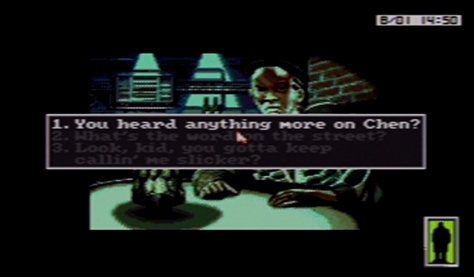
Cliffhanger [Sega CD] – First Impressions
June 15, 2012
When the failed heist of a treasury plane leaves John Lithgow and his group of robbers abandoned in the Rocky Mountains, they force rescuer/mountain climber Sylvester Stallone to locate the lost suitcases of money and get them out alive. This introduction is what one gleams after watching the ten or so minutes of low-quality, grainy footage that sets the stage for the first level of the Sega CD video game based off of the 1993 film, Cliffhanger. Developed by Malibu Interactive and published by Sony Imagesoft, Cliffhanger features awful beat ‘em gameplay interspersed with fast-paced 3D snowboarding and dire video clips.

Fighting the dozens of enemies was unpleasant thanks to Stallone’s slow movement, limited selection of attacks, and poor hit detection, among other deterrents.
After locating one of the lost suitcases, Stallone is on his own as he proceeds to traverse and scale peaks that contain way more enemies than one was lead to believe was with Lithgow. The beat ‘em up gameplay that ensues is awful. The stages are full of banal action that manages to be infuriatingly cheap. Stallone moves like a child with a dozer load in his diaper and after every hit he takes, he collapses onto his batch of brownies. This Stallone is not the Rocky who can take the hits, and deal them out with more determination and intensity than his foes. Thankfully, the enemies also can’t take a beating and are out cold after two or three hits. But when it comes to scaling cliffs, don’t even bother. Resting on perches are snipers who can’t be touched, so don’t worry, Stallone’s just going to have to man up and take a few bullets. The lives will be lost and continues will be used – thankfully the game doles out a combined twenty-one chances to outwit Lithgow, but you’re gonna blow through them on the snowboarding sections.
When he’s not killing thugs with his bare hands (or wussing out by using a knife or gun), he’s hitting the slopes and getting his daredevil thrills by outrunning avalanches. How Stallone can go from falling on his ass to outrunning avalanches is a weird disparity in pacing. These stages of the game are quasi-3D with Stallone shredding into the screen while dodging boulders and bushes. Speaking of infuriatingly cheap, it was one of these stages that I rage quit and decided I could spend my time better. Still, the fast-paced gameplay of the snowboarding sections was the complete opposite of the worthless beat ‘em sections and for that, I almost enjoyed it.

This game was released for other systems back in the day (Genesis, SNES, Game Boy, and Game Gear) but this was the only version to feature snowboarding sections.
Cliffhanger’s beat ‘em up gameplay pales in comparison to the titans of the genre and its snowboarding sections are a thrill, but too long for their own good. The soundtrack was ridiculously clear, but I don’t care. The best part of Cliffhanger was the twenty minutes of malodorous video, and that’s saying something.

Rocket Science Games, the developer, was founded by a prolific entrepreneur and a workaholic game designer in 1993 and later received a $12M investment, in part from Sega.
At first glance, Cadillacs and Dinosaurs: The Second Cataclysm is very interesting. This Sega CD/PC video game is based off of the Xenozoic Tales comic books/TV show and it features graphics and cutscenes that stay true to this heritage. Another way the game sticks to its foundation is through the inclusion of the zany post-apocalyptic story. I perceive the developer’s as having a passion for translating this intellectual property into a video game, and yet, my first impressions of The Second Cataclysm are negative. Repeatedly playing the first level of the on-rails shooter deflated my morale until I eventually threw in the towel.
Through a brief comic book in the manual and an introductory cutscene, I was enlightened on the setting and plot points of The Second Cataclysm. Many hundreds of years in the future, Earth was ravaged by unnatural disasters and the remaining humans survived and thrived underground. When they returned to the surface, the planet was overrun with the remains of their civilizations and confusingly, dinosaurs. They’ve learned to follow the “machinatio vitae” which calls for a balance between nature and machinery and when a race of highly developed ground dwellers sense an upset in this balance, they seek out all around good guy Jack Tenrec to prevent another cataclysm like the one that devastated Earth hundreds of years before.

The game looked good (considering the terrible grainy picture), but the gameplay was bland and difficult.
With his trusty accomplice Hannah Dundee and his 1953 Cadillac, Jack sets out to stop Wilhelmina Scharnhorst’s megalomaniacal ambitions. His road to success is littered with obstacles however, first and foremost that there isn’t one!
As I cruised through the jungle in Jack’s hot ride, I’d try my best to avoid rocks, logs, and dinosaurs and if I couldn’t, I’d have Hannah blast them with her gun. I had to keep an eye on the path ahead though because the road to success wasn’t straight. I’d have to make split-second decisions when I came to forks in the road and I’m not quite sure if this holds true in the earlier stages, but the manual leads me to believe that I could go in circles. Keeping the “machinatio vitae” in mind, I’d try my best not to blast dinosaurs because when I did, my time limit to reach Scharnhorst decreased.
Looking back, I probably was going in circles. Still, I would stick it out for as long as I could until the Cadillac was too beat up from obstacles or I ran into a dinosaur preventing me from completing the first stage. I’m not all that interested in trying to best myself and complete the first stage to, reportedly, do the same thing in the same environment six more times until the game alters its stage design before capping off Jack and Hannah’s journey. An ambitious game with tepid gameplay – Cadillacs and Dinosaurs: The Second Cataclysm is a game that can remain extinct.
Battlecorps – First Impressions
June 9, 2012
In my years of collecting video games, I’ve made an observation. When developers were making their first forays into first-person and polygonal video games, the first-person mech genre was a popular choice to test the waters. Battlecorps for the Sega CD falls into this category. Developed by Core Design and published by Time Warner Interactive, Battlecorps features colorful graphics, but poorly executed gameplay.
As one of three characters, I began missions by listening to a briefing from the Comedian-inspired Lieutenant Calgary. With my objectives known, I’d pilot a bipedal attack machine (BAM) through enemy-riddled levels and destroy the infrastructure of rival corporations.
Controlling the BAM was doable but aiming was a hassle. With only three buttons and a directional pad, Core Design was limited in their choices for sure, but they still chose to overuse the controller. They opted to give players the ability to aim up, down, and around, but doing so required players to shift the functionality of the d-pad depending on what they wanted it to do: pilot their BAM or aim. Enemies won’t wait for you to aim at them so taking damage is an unfortunate necessity. This is a design choice that hampered the game and could’ve been avoided by eliminating the need to aim at all.
The confounding controls ire me and the gameplay revolving around walking slowly and shooting deserves only this single mention, but I do like the graphical style. The environments are colorful and the game is a hot pixilated mess. It’s 3D much in the way that Doom was 3D; objects are made of pixels and as camera moves, so too do they. What’s not cool is the limited field of vision. The game replicates the insides of the BAMs as though I was actually in one, and because of radar and various screens, my view of the world is limited.

Like a ticker on the bottom of a TV news channel, the ticker in the topmost portion of the BAM warns against enemies and mines.
Battlecorps’ tepid gameplay and complicated controls left me not wanting to return to its battlefield again.
Lethal Enforcers – First Impressions
June 7, 2012

On consoles, Lethal Enforcers was released in a massive cardboard box that could contain the Konami Justifier.
Back when arcades ruled the video game roost, light gun games were widespread. The genre wasn’t as ubiquitous on home consoles, but it seems like each console from back in the day had a light gun. One game with a big presence back then was Lethal Enforcers. It was originally released as an arcade game in 1992, but was ported to the Genesis, Super Nintendo, and Sega CD from 1993-1994. Developed and published by Konami, each version came bundled with the Konami Justifier, a blue light gun modeled after the Cult Python, the iconic .357 Magnum revolver. Enabling cooperative play is the harder to find pink light gun, although it works across all three platforms.
Lethal Enforcers contains little narrative, but little is needed. Crime is being committed and as a cop, it’s your (and your partner’s) duty to uphold the law. You’ll shoot through scenes in which bad guys pop their heads up from cover looking to blow yours off. Without quick timing and precise accuracy, game over comes quickly. Once those qualities are on lock-down though, you might just be able to make your city a little cleaner. While that sounded like an ad, that’s pretty much the best way I can sum up the game.
My friend and I played the Genesis and Sega CD versions of Lethal Enforcers and I only noticed one difference between the two versions – the soundtrack of the Sega CD version was of a higher quality. Both games looked identical, although the Sega CD version should look much better than its Genesis counterpart. I imagine the Super Nintendo version is identical to the Genesis version, although without playing it myself, I can’t say with certainty.
My friend and I had a rough go at the game. It was easy to complete the first level, a bank robbery, and even do so without losing lives, but to unlock the next level, we had to have 70% accuracy. We eventually managed this, but the second level, a trip to Chinatown, upped the difficulty, while also asking us to have even better accuracy. The game has five stages and I’m sure this continues to be the case throughout the game.

This scene played like an episode of The Flintstones – my friend and I saw, like, thirty National Rubber Stamp Companies.
I really enjoy light gun games, and Lethal Enforcers seems to be one of the genre’s better examples. It’s tough, but it doesn’t force players to memorize enemy locations. With quick reflexes and good accuracy, anyone can have fun. Playing cooperatively is a treat because at that point, you’re into the experience for at least thirty bucks, but it’s definitely much more fun with a partner. Lethal Enforcers is a fun game, although for the best experience, it will be slightly costly/difficult to track down. It’s worth noting that Lethal Enforcers won’t work on HDTVs so if you’re interested, make sure you have a CRT TV or something you can play it on.
The Adventures of Batman & Robin (Sega CD) – Review
April 25, 2012
Imagine that you’re watching the nineties cartoon show The Adventures of Batman & Robin, also known as Batman: The Animated Series. Instead of being treated to the admired artwork, you’re instead greeted by grainy, low-quality video. Now imagine that after every few minutes, you’re forced to drive the Batmobile through endlessly crowded environments such as the city streets of Gotham or a devious race track of the Joker’s. This sounds familiar? Well then, you must’ve played the Sega CD version of The Adventures of Batman & Robin.
I bet that when you began playing, you didn’t expect the game to consist solely of driving, with the exception of the finale where you got to pilot the Batwing. Now I only bring this up because I remember how you complained during the first mission. You got frustrated very quickly when you kept getting killed when fighting the bosses of the mission. You had to dodge a plethora of hard-to-miss attacks all while trying to take out the baddies. It upset you so much because it took you many tries to get to this point at all. The driving portion consisted of congested city streets that required pinpoint timing; otherwise you wouldn’t be able to get to your destination before time ran out.
Sure, it took you a long time to get your groove, but when you did you were able to blow through much of the game on your first try. Then again, the game really only tested your reflexes. I do remember you enjoying the later missions; the ones that took place on a casino-style game board of the Riddler’s, a circus-style race track of the Joker’s, and the high-flying Batwing level through bridges. Well, never mind, you only liked the last one because it was slightly different. Speaking of differences, the animation and story was unique to this game, being referred to as “the lost episode”. It featured the aforementioned villains as well as Robin, Poison Ivy, and Rupert Thorne and you liked that part of the game, besides the low-quality video.
So you said you grew up on the classic cartoon show, what did you think of the Sega CD game? Oh, well, that’s about right. I mean, I’ve pretty much discussed the game in detail and I wasn’t super positive, so that makes sense. I wouldn’t play the game again, or recommend it to others either. It’s a shame Clockwork Tortoise and Sega couldn’t put out a more polished game.
Wheel of Fortune – Review
August 5, 2011
Hey guess what? I have another version of Wheel of Fortune that I’m going to talk about. This time it’s Wheel of Fortune for the Sega CD. It was developed by Absolute Entertainment and published by Sony Imagesoft in 1994. The format is standard Wheel of Fortune fare but this version has the inclusion of video footage!
Wheel of Fortune for the Sega CD played identically to Wheel of Fortune: Deluxe Edition for the Super Nintendo, the game I wrote about a week or two ago. My friend and I played through three rounds attempting to solve puzzles with the most amount of money, and the winner of these rounds proceeded to a bonus round.
This version boasted more puzzles than the Super Nintendo version, but the few my friend and I came across didn’t seem well known. The one that sticks out in my mind was “pooped out to lunch”. I understand what it means, but I’ve never heard anyone phrase it that way.
The real reason to play the Sega CD version however is the inclusion of video footage. Vanna White is featured prominently in the game, and there is a little video footage of each contestant too. The video quality is very poor however (typical of Sega CD games) and it really slows the pace of the game. Vanna would announce whose turn it was, each time using the same line and this got old fast. Once we learned we could skip this we did. There was plenty more video footage of Vanna too, but it grew old fast as well.
This version was again a competent recreation of the TV show, and the rivalry between my friend and I was still there, but the puzzles didn’t seem great. The video footage included was entertaining, aka laughably bad, but it really slowed down the pace of the game. It was fun to play to see the video, but for just wanting to compete, Wheel of Fortune: Deluxe Edition is a better choice.
Mansion of Hidden Souls – Review
May 19, 2011
Mansion of Hidden Souls is a peculiar game. Everything about the game was creepy. The poorly rendered graphics added an odd vibe, while the plot and setting were downright strange. I was pleasantly surprised by the game however. A friend and I played through the game together and enjoyed solving the puzzles and unraveling the game.
Developed by System Sacom and published by Vic Tokai, Mansion of Hidden Souls was released for the Sega CD in 1994. My friend and I took on the role of a young boy looking for his sister who has run away to a creepy mansion in the woods. He soon discovers that people who stumble upon this mansion are turned into butterflies, and that his sister finds this appealing. He then sets out to find her and get out of there.

The billiards room is quite detailed and contains the black painting that helped my friend and I very much.
There were plenty of obstacles standing in his way though. The game is played from the first-person perspective, meaning my friend and I took on the role of the young boy directly. We chose where to go in the mansion and explored it in its entirety. The game uses pre-rendered backgrounds so it has a distinct look to it and is quite detailed, but due to the Sega CD, the game appears very grainy. Rather than sprites which were predominately used in games of that era, pre-rendered graphics looked like “realistic” interpretations of items.
We chose which direction we wanted to go and the young boy would walk where we told him. We stumbled upon objects or areas that could be interacted with and, at the right time in the game, something important would happen. Everything in the game is there for a reason, there isn’t anything extra. By the end of the game, we had utilized everything that we could interact with, which led to a lot of backtracking.
Mansion of Hidden Souls takes place entirely in the mansion and it is a fairly large environment to explore. Each room has a theme and they are all quite varied. The majority of the rooms also contain a butterfly, who was once a human. The butterflies retain their ability to communicate with the boy and some are helpful while others are spiteful. The great thing about being on a compact disc is the ample storage space allowed for voice acting. The unfortunate thing about the voice acting is how poor it is or what I should say is the voice acting is comedic; each butterfly had a unique accent that was butchered by the voice actors.
Early on we had limited access to the mansion as we lacked keys, but in one of the rooms is a black painting that gives a glimpse of what we need to interact with next. This was very helpful. A lot of the puzzles my friend and I figured out before checking the black painting, but with so many intricate objects to interact with, and some uses being less obvious than others, it was great to have something to turn to.
For the first half of the game, we explored each room, learning where objects were and received input from the butterflies. Once we retrieved the main character’s sister (early on in the stages of human to butterfly transformation) we had to escape from the mansion’s owner. At this point we received a clock and had one hour (in-game time) to complete the game. Time didn’t pass when we stood still which meant we could think about what to do, and it seemed as if we had ample time to check the black painting. This time limit added an interesting dynamic that we didn’t find annoying thanks to the ability to save in case we did make a mistake (which happened a few times) and died because of it.
I took a gamble with Mansion of Hidden Souls. I saw it for sale and having never seen a copy of it before, purchased it. I didn’t have any intention of playing it as soon as I did, but I found a peculiar, yet halfway compelling adventure that was short enough for my friend and I to complete in one sitting. We made a lot of the connections about the use of objects ourselves but the ability to seek out the black painting for what to do next was helpful. Mansion of Hidden Souls was a creepy game that I had more fun playing through than I expected I would.