When Peggle: Dual Shot failed to fill the role of my next “bedtime” game – a logic-orientated puzzle game, preferably – I went in an entirely different direction. I’d been longing to play some of the classics from the Nintendo DS library that I’d missed, and compiled a shortlist that contained the debut entries in the Phoenix Wright, Etrian Odyssey, and Trauma Center series. The unique qualities and positive reputation of each had drawn me to them for years – and I still plan on playing the “runners up” at… some point – but I ultimately went with the latter of the trio, if anything for its comparable brevity.
When I started playing Peggle: Dual Shot, I envisioned that it could be my next “bedtime” game. That is, something in the vein of Picross or Pic Pic, a game where I could complete puzzles through an almost Zenlike unthinking process, and perhaps listen to a podcast or otherwise just drift off to sleep. Which is a bit of an oxymoron isn’t it, since those games feature logic puzzles, which uh, require you to, you know, think.
In the lead up to my recent week of vacation, I planned out a few things I wanted to accomplish. Top of the list was getting some car repairs done. I also wanted to spend at least one day with my wife driving around a nearby Oklahoma county, hunting for historical markers and eating local BBQ. There were a few odds and ends to be done around the house as well but when it came to video games, I had only one objective: begin, and hopefully complete, Bloodstained: Ritual of the Night. That didn’t happen, but before I even started compiling my to-do list I was already preparing a contingency plan. Continue reading Castlevania: Order of Ecclesia [Nintendo DS] – Review→
Released for the Nintendo DS in September 2008, Sonic Chronicles: The Dark Brotherhood is one of the most unique games in the iconic series. Unlike almost every other entry in the franchise, it eschews fast-paced platforming in favor of turn-based battles. This is unsurprising considering BioWare, the Edmonton, Alberta-based developer responsible for it, is best known for their various role-playing games. It features a few trademarks associated with their gameography but plays more like their spin on the Japanese RPG. Continue reading Sonic Chronicles: The Dark Brotherhood [Nintendo DS] – Review→
So, remember earlier this year when I began my Xenoblade Chronicles review talking about how I no longer had the time for lengthy RPGs? Well… apparently I do. Three months and 125 hours later, I’m finally done playing that game’s sequel, Xenoblade Chronicles X. Originally published in Japan by Nintendo on April 29, 2015, Monolith Soft’s Wii U follow-up arrived in the west half a year later, on December 4, 2015. Featuring no narrative continuity with its predecessor, this entry recounted humanity’s survival on an alien planet following the destruction of Earth. In nearly every way, the developer’s improved upon and expanded the systems they introduced in the previous game, making for an incredibly deep, and fulfilling experience. Continue reading Xenoblade Chronicles X [Wii U] – Review→
Although Sudoku had existed in one form or another since the late 19th century, it didn’t gain in popularity in the United States until the mid 2000s, when it became a feature of practically every newspaper. I was in high school then and devoted crucial time to solving these addictive new logic puzzles instead of paying attention in class, perhaps explaining why I excel at Sudoku but couldn’t tell you much about chemistry… The Nintendo DS was beginning to catch fire around this time as well, after Nintendo realized it could capitalize on an untapped market: the non-gamer. Releases like Brain Age appealed to many demographics and showcased the platform’s unique abilities in handling games such as Sudoku. A wave of software followed and while my experience with Sudoku on the platform is limited I’m nonetheless impressed with Sudoku Gridmaster. Continue reading Sudoku Gridmaster [Nintendo DS] – Review→
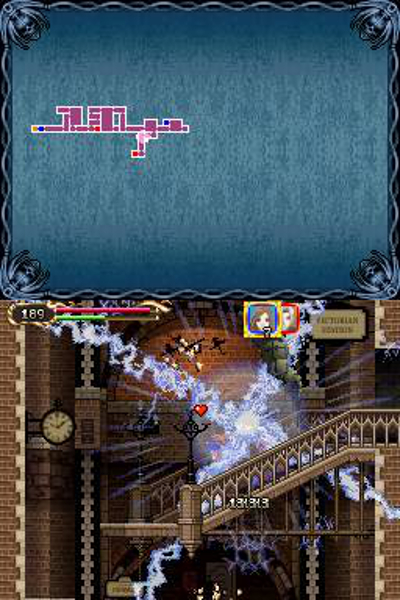
When I talked about Fallout Shelter last week, I began by considering it in a vacuum. Without partners playing too, it grew to resemble a chore more than an enjoyable escape. I feel like taking the same approach with Castlevania: Portrait of Ruin but for a different reason. In a vacuum, this game is practically the pinnacle of the 2D action-adventure genre. The addictive blend of action, exploration, and role-playing elements that the series is known for, still make up the core experience of this game and pair well with new additions. Level design remains fresh throughout, in part due to the top-notch audio/visual qualities and varied surroundings. The reasons to continue playing after completion are immense as well, but, this is like the fifth Castlevania of this style I’ve played, and while they’re individually superb, they elicit less exhilaration after each completion.
Per usual, the animation was top-notch.
When it was released for the Nintendo DS in late 2006, Portrait of Ruin was joining an already extensive collection of similar Castlevania titles that had released relatively recently. Koji Igarashi and his crew at Konami differentiated this game in a few ways, most notably, by focusing on two characters instead of one. The plot centers on Jonathan Morris’ quest to quell Dracula’s uprising amidst a war-torn Europe circa 1944 with his partner Charlotte Audin. He resembles the typical Castlevania protagonist in many ways while she is a spell caster with a growing repertoire of spells, another series staple.
I could freely switch between the two at all times and this allowed me to dabble with both combat styles – weapons with him and magic with her. These two styles were vastly different in execution and perhaps because of my familiarity with previous entries, I stuck with Jonathan. When not actively controlled, the partner was still useful. They would automatically attack on-screen enemies, albeit with little intelligence. This was beneficial in dealing with enemies but it proved most worthwhile in drawing enemy aggression towards the partner, allowing me to attack from behind. Outside of combat, the duo was put to use in progressing past a few (generally half-assed) puzzles. The most memorable of these had both characters riding motorcycles and tasked me with switching between them in order to make sure neither was knocked off by various obstacles. It was a fast-paced puzzle that made me stop and think of a viable solution, unlike most others.
The game had a limited number of NPCs, but each was integral to the plot.
Additionally, the game was distinguished by the variety of locales Jonathan and Charlotte traversed. Now, the primary setting was Dracula’s Castle (naturally) but much of the duo’s time was spent exploring the paintings strewn about, a la Super Mario 64. In keeping with the series, these maintained a gothic design. They transported the pair to the streets of a bombed-out European city, a nightmarish circus, and many more unique backdrops that would’ve seemed out of place as disparate areas of the abominable abode. The series has always attempted to segregate Dracula’s Castle with diverse milieus but this is the best example I’ve seen.
Although Jonathan’s quest was to banish Dracula’s Castle, that vile vampire wasn’t an issue until late in the game. While the castle had arisen because of the agony and hatred within humanity during this period, another vampire took advantage of the castle’s powers for his own agenda and prevented Dracula from reviving. That vampire, Brauner, ultimately worked towards the same end goal of humanity’s destruction, but did so out of the hatred he felt for losing his daughters during the First World War. Brauner was able to harness the power of Dracula’s Castle through his paintings. With assistance from newfound friends and through the evolution of a subplot or two, Jonathan and Charlotte were successful in cleansing the castle of Brauner’s influence and ultimately dealing with Dracula and his ilk.
Some sections of Dracula’s Castle may look familiar to veterans of the series.
There were plenty of reasons to keep going once the story was finished too. Exploration and the mapping of Dracula’s Castle has been a core component of the series since Symphony of the Night, and this game doesn’t disappoint with its 1,000% MAP COMPLETION RATE! That number is perhaps artificially high because of the multitude of paintings, but there is a lot to explore nonetheless. Moreover, there were many collections to complete such as obtaining all items or filling out the bestiary and mastering each sub-weapon, powering them up in the process. These are customary features for the series but also available were sidequests from one of the duo’s associates. I believe this was a first for the series and I had completed maybe 15% at game’s end after passively trying, so there’s much to do on that front.
Two more sets of playable characters could also be unlocked and both changed gameplay dramatically. The environment remained the same with both but the equipment and magic customization was backpedaled completely and a story was basically nonexistent. One pair of characters was a throwback to the classic days of the series with a focus on sub-weapons and the legendary whip, Vampire Killer. This duo was overpowered and playing with them felt like I was in “God mode.” The other duo utilized the touch-screen exclusively. The touch-screen was integrated into the game elsewhere but I literally never used it. The execution with these two was actually very intriguing and their individual means of attacking required different touch-based actions. A Boss Rush mode was also available after completion as well as a co-operative mode (multi-card only).
The duo had access to super-powerful co-op attacks that drained their MP.
Castlevania: Portrait of Ruin has all the staples I’ve come to expect from the series as well as a few differentiating features. The core of these, a focus on two characters, helped to freshen the formula but it was probably the variety of settings that kept me most entertained. Not to mention the accoutrement found in the various collections to complete, sidequests to beat, and unlockables to try out after the plot had wrapped up. The more modern backdrop and the twist on the classic premise were appreciated as well. I think this is probably the most complete Castlevania I’ve played of this style, but I don’t think it tops Aria of Sorrow for me. That was my first foray into the series and each one I’ve played since has been chasing that experience. They’ve all been outstanding, but like the saying goes, I’ll never forget my first, and I’ll forever be comparing successive entries to it.
Zoo Keeper is a game that has intrigued me since the early days of the Nintendo DS. In North America, it was the first game to release outside of the system’s launch window. A launch window that was a veritable drought – after the system’s November 21, 2004 launch, there weren’t any releases until this January 18, 2005 title. Even then, I don’t recall there being an actual noteworthy release until June 14, 2005 – Kirby: Canvas Curse. My curiosity in this game shouldn’t be construed as a belief in its quality either; after ten years of thinking about it, I refrained from hyping myself up for it which was a good call, as it’s merely a basic match-three puzzle game.
You crazy lion.
There are a handful of modes available to play, each a variation on the familiar match-three gameplay present in many like puzzle games. The quest mode in particular is quite ingenuitive. It’s not a beefy affair however, nor is there a lengthy distraction present. The drive for high scores or killing time would have to be one’s long-range motivator with this game. Fortunately, the underlying gameplay is solid and enjoyable. Bearing in mind that this released a year or two before the dawn of the App Store, this was a predecessor of sorts to the touch-controlled match-three games that are a deluge now. I wouldn’t say it’s particularly progressive in what it is – it’s just a basic, solid puzzle game that incorporated touch controls well.
The scoring in quest mode was unlike anything I’ve seen.
It’s worth noting that I have played an Android version of Zoo Keeper in my ten year quest to experience this version. A year or so ago I downloaded a multiplayer focused version and had little more than a passing session with it. That says nothing of its quality and perhaps everything with my desire to abstain and experience the Nintendo DS game fresh. Ironically, I wound up not spending too much time with it either – no more than a few hours. Again, that says nothing of its quality. As I mentioned before, it’s a basic puzzle game that plays well. It may have curried more favor with me before my exposure to the match-three hell (heaven?) that is mobile gaming. It has a cute art style too.
I came to Radiant Historia with high expectations. After all, it arrived from Amazon on a Friday with my first case of Surge since the late 1990s. But seriously, having waited to play it for a few years, I’d built it up in my head, and for the most part, it met my expectations. The characters were well-defined and featured substantial development while the time-traveling story touched upon many mature themes. In general, the game featured a high level maturity – something I rarely, and unfortunately, don’t associate with many JRPGs.
What I wasn’t expecting was that my attention would be diverted while I played through it, turning the middle third into more of a slough. Coincidentally, this was also the same section where I began to notice poor qualities surrounding the battle system. I grew to strongly dislike the combat, and for a while, avoided enemy battles altogether. My opinion never rebounded, even though my overall opinion of the game did when I once again devoted my full attention to it.
The game’s setting reminded me of Final Fantasy VI.
The game is set on the war-torn continent of Vainqueur, home to a handful of key countries and races. The setting is mostly fantasy, but there is a strong steampunk influence. Although I haven’t played much of it, this game reminded me strongly of Final Fantasy VI. Among the countries calling Vainqueur home, Alistel and Granorg are dominant. They’re the two archetypal western civilizations, populated with modern folk living in the capital cities. Less prominent nations included those occupying sandy desert oases and forest villages, home to beastkind. In other words, this game is in the mold of classic JRPGs.
On a more personal level, the game also featured typical characters that ran the gamut from amnesiac protagonist, closely related and destined royal heiress, to the strong silent beastman. Despite the seeming caricatures in play, the characters themselves were actually much more complex than I’d lead you to believe. As the plot unfolded, allegiances changed and personal feelings were put on the backburner for affairs more important than simply seeing one country dominate another; affairs such as the revelation of truth to the masses and the salvation of the world.
The battle system was relatively simple, and it bogged down my overall impression of the game.
Ultimately, the game featured two types of characters: leaders and followers. When untruths became ever more evident, some characters rallied behind their misplaced beliefs and held firm to the orders of their leaders. Others saw through to the eventual outcome and changed course as needed. Regardless, the actions of all involved were compelling because the characters were well-defined and acted in ways resonant to their continual evolution. The final third was particularly engrossing as the story was reaching its climax and the true antagonist was revealed. That character’s actions were understandable, and the pivot made to the “dark side” was something palpable. That character was human and not just a soulless antagonist, à la Final Fantasy IV’s Exdeath.
And still, there was one more piece binding the narrative together: time travel. Thanks to an item bestowed upon the protagonist early on, two timelines were accessible and freely available to jump between at all times. The standard and alternate timelines illustrated how things would be different through decision making, although both culminated in a shared conclusion. Often, I would stick to one timeline until I reached an impassable portion. Jumping to the other timeline would eventually yield a resolution to my problem in the other. Both had to be seen through to their conclusion to reach the end, but there were many sidequests to perform all the while, reminding me a little bit of The Legend of Zelda: Majora’s Mask and the Mass Effect series.
Those two were instrumental in the time traveling.
What dragged down my otherwise high opinion on the game was the battle system. Encountering on-field enemies led to battle scenes featuring said enemies on a 9×9 grid. Using the three members of my party, I did my best to group as many enemies together on the same grid. When done correctly, I could damage these enemies with each attack or apply the same status ailment. Beyond learning new moves to assist in this goal, that was the extent of combat development. In itself, that’s not a negative, but around the second third of the game, just dealing with the basic enemies was a tough task.
This turned into such an annoying aspect for me that I turned to avoiding enemy encounters. I never allowed my party to get under leveled, but it really felt like I was missing something. I turned to GameFAQs for recommendations, but sure enough, my party level was in keeping with suggested levels. However, I never deviated from using the same two optional allies. Due to timeline jumping, my party consistency was always changing, with the exception of these two characters, generally. Using other party members would’ve required much grinding to get them on the same page, so why bother? This probably contributed to my dislike for the combat and battle system, but it wasn’t that great anyways.
There were a few “puzzle” segments revolving around block-pushing.
Ultimately, Radiant Historia left me pondering the topic of personal purpose and contributions to the greater good of the world. On a more granular level, many other themes were touched upon, and it was a wholly engrossing game with great character development. What’s more, the time traveling mechanic was more than a fun novelty, although it was that too. It offered a diverse creative opportunity for the story to develop while providing many ingenuitive sidequests. The battle system was a letdown however, leading me to try and entirely forego any unnecessary experiences with it. Finally, I learned that I can’t hope to enjoy an involving video game, if I’m also trying to watch The X-Files.
When you have a video game collection like mine, it can be hard to play all of the games. This is especially true when additions are made on an almost weekly basis. Still, I appreciate nearly every game I’ve accumulated for this reason or that. In the hopes of improving my writing through continuous effort and promoting ongoing learning of these games, I’m going to compose brief, descriptive articles.
This is a fairly recent addition to my collection. During one of the more recent buy 2, get 1 free promotions at Vintage Stock, I acquired this game. I have yet to play it, and I’m doubtful that I’ll complete it once I check it out. It’s an old-school first-person dungeon crawling RPG which I can dig, but I’m unsure of the game’s quality. The game is sitting at 55% on GameRankings, and even taking into account that RPGs generally don’t fare too well with western critics, that’s low. However, Ii do enjoy making graph paper maps and this game may bring out that need and other minor OCD tendencies.
Deep Labyrinth was developed by Interactive Brains and originally released as a mobile game in Japan on December 1, 2004. They ported it to the Nintendo DS and it was published by Atlus in North America on August 15, 2006. It has some revered individuals behind it according to Wikipedia; namely, the script writer behind many Square classics Masato Kato and the prolific composer Yasunori Mitsuda.
Share this:
Twitter
Facebook
Tumblr
Like this:
LikeLoading...
The internet's source for Mansion of Hidden Souls.
![Trauma Center: Under the Knife [Nintendo DS] – Review](https://mybrainongames.files.wordpress.com/2021/12/trauma-center-under-the-knife-nintendo-ds-north-american-box-art.jpg?w=672&h=372&crop=1)

![Peggle: Dual Shot [Nintendo DS] – Review](https://mybrainongames.files.wordpress.com/2021/11/peggle-dual-shot-nintendo-ds-north-american-box-art.jpg?w=672&h=372&crop=1)

![Castlevania: Order of Ecclesia [Nintendo DS] – Review](https://mybrainongames.files.wordpress.com/2019/07/castlevania-order-of-ecclesia-nintendo-ds-north-american-box-art.jpg?w=672&h=372&crop=1)

![Sonic Chronicles: The Dark Brotherhood [Nintendo DS] – Review](https://mybrainongames.files.wordpress.com/2019/06/sonic-chronicles-the-dark-brotherhood-nintendo-ds-north-american-box-art.jpg?w=672&h=372&crop=1)

![Xenoblade Chronicles X [Wii U] – Review](https://mybrainongames.files.wordpress.com/2018/07/xenoblade-chronicles-x-wii-x-north-american-box-art.jpg?w=672&h=372&crop=1)

![Sudoku Gridmaster [Nintendo DS] – Review](https://mybrainongames.files.wordpress.com/2018/01/sudoku-gridmaster-nintendo-ds-north-american-cover.jpg?w=672&h=372&crop=1)

![Castlevania: Portrait of Ruin [Nintendo DS] – Review](https://mybrainongames.files.wordpress.com/2015/09/castlevania-portrait-of-ruin.jpg?w=672&h=372&crop=1)


![Zoo Keeper [Nintendo DS] – Review](https://mybrainongames.files.wordpress.com/2015/06/zoo-keeper.jpg?w=672&h=372&crop=1)


![Radiant Historia [Nintendo DS] – Review](https://mybrainongames.files.wordpress.com/2015/02/radiant-historia.jpg?w=672&h=372&crop=1)


![Random Game #29 – Deep Labyrinth [Nintendo DS]](https://mybrainongames.files.wordpress.com/2014/12/deep-labyrinth.jpg?w=672&h=372&crop=1)

 My Brain on Games