Probably the quintessential example of a cult classic in the video game industry, at least here in the United States, the Super Nintendo RPG EarthBound had an underwhelming debut when Nintendo released it June 5, 1995. The SNES was reaching the end of its commercial lifecycle, and RPGs on the system had matured to include ever more complex gameplay systems and grandiose visuals. Heck, the Sega Saturn had released a month prior, Sony’s PlayStation was on the horizon, and Nintendo was already discussing the next generation Ultra 64 publicly, so it seemed 2D graphics were on their way out. Yet here comes this simplistic looking game based in a reality not unlike our own instead of an imaginative fantasy or sci-fi backdrop. Similarly, the plain combat system could’ve been considered a throwback, even then. But, there was an audience for the game, and in the years since its debut, that audience has grown into a thriving fandom. Now that I’ve experienced firsthand the charming, unique adventure that EarthBound offers, a fandom so vibrant is well deserved, I’d say. Continue reading EarthBound [Super Nintendo] – Review→
My interest in the Arkanoid series piqued after reading a Retro Gamer article chronicling the series. I’d never played a game in the series, although like most everyone else, had played a game like it. So, when the Oklahoma Video Game Exhibition came around and I found what I believed to be a reasonably-priced complete copy of Arkanoid: Doh It Again, I snagged it. Since then, I’ve played the game a great deal, enough to beat it, even. There were interesting touches to differentiate it from other similar games, although I eventually grew bored of it. The bulk of my time was enjoyable, but the times that weren’t, were tortuous.
The rounds were usually made to look recognizable.
The game consisted of 99 rounds with each one featuring a unique arrangement of blocks. Most were easy, usually requiring no more than a handful of attempts. However, there were a few, particularly rounds 95 and 99 that took me upwards of fifty attempts; seriously, like fifty attempts. These were awful and truly tested my determination to see the end. Generally, the tougher rounds were made so due to the inclusion of gray and gold blocks. Gray ones took multiple hits to destroy while gold ones were unbreakable. When these were used in combination, and arranged in specific ways, my success was based on persistence and a lot of luck.
Breaking up the formula were boss fights. These took place every eleven rounds and featured one of three bosses. If you’ve done the math, you know that means I fought each boss three times! This was a letdown, especially when I reached round 99 and sure enough, just a repeated boss. To be fair, they grew tougher with each appearance, although nothing else changed about them. I simply had to hit them more times. And, as I mentioned in the previous paragraph, the final round ate up my time and patience. Eventually though, I overcame, able to walk away with the satisfaction of beating the game, and little else.
Two-player modes (competitive and cooperative) round out the game and enhance the replayability. Honestly, this is where the game shines, too. Playing solo, the game represents a near-perfect podcast game, which is to say it can be a little boring. Throwing another person into the mix livens the atmosphere and makes for a fun experience – specifically cooperatively. There is a level editor mode as well, but that’s not my cup of tea; and the game also supports the SNES mouse which seems like an odd bullet point, but it probably has its perks in level creation.
One of the three boss fights, and one of the two instances of Doh.
Arkanoid: Doh It Again doesn’t have a lot going for it. Persisting through the game’s 99 rounds yields some good times, but eventually, those are overshadowed by the hours spent beating a select few stages. I’m still interested in playing other games in the series, but won’t necessarily seek them out. Perhaps the biggest personal revelation, however, was the fact that this game came out on the Super Nintendo in November 1997. That’s so late in the SNES’ lifecycle! I mean, November 1997. NOVEMBER. 1997.
Okay, Final Fantasy V hasn’t been released as much as its predecessor. In fact, the first time it was officially released outside of Japan was with the American release of Final Fantasy Anthology for the PlayStation. That was in late 1999 – basically seven years after it was originally released on the Super Famicom in late 1992. It took another two and a half years for the game to eventually be released in Europe. Since then, it has been released on the Game Boy Advance and on iOS and Android platforms.
Looks familiar, no?
As they did for the Super Famicom release of Final Fantasy IV, Square opted for a cutesy cover over the traditional usage of Yoshitaka Amano’s artwork. Again, he was relegated to the logo design. This cover hones in on the wanderer Bartz, and easily conveys this fact. The logo chosen for this game includes a dragon intertwined with the font. This is also apt as dragons play a significant role in the narrative.
Of the covers Final Fantasy V has been released with over the years, this is my favorite.
The game was subsequently released on the PlayStation in 1996. This is my favorite cover that’s been used for one of the game’s releases. The cutesy character design again reigns supreme and this time it’s highlighting the many job classes. With the exception of two as there were twenty-two job classes in the original.
This is the version I have. It also includes Final Fantasy VI, which I will dive into soon.
So this is the version of the game that I possess. I really dig the box art, but it pertains to Final Fantasy VI, so it’s not really comparable in this article. I will mention that I had difficulty playing the disc on the PlayStation 3. There is a save screen glitch that the game freezes at. The glitch is still a factor when playing the disc on the PlayStation 2, but on that system, it’s only a graphical glitch. The menu can still be navigated and the game doesn’t freeze.
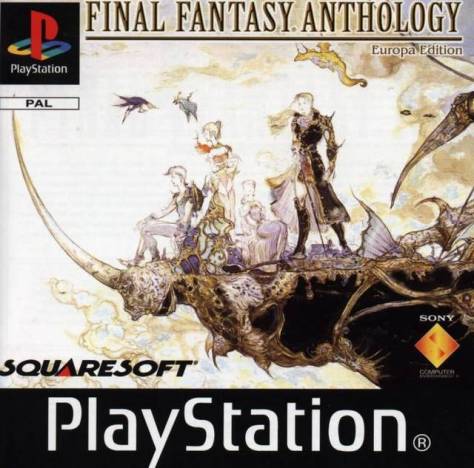
The European version includes Final Fantasy IV instead of Final Fantasy VI.
For the European release of Final Fantasy Anthology, this game received the honor of selling the game. If it’s successor was included in this package, I’m sure that wouldn’t have been the case. Still, this is prime Amano displaying the cast on one of the many ships.
The Japanese release of the GBA version.
For the Game Boy Advance release, a slew of extra content was added including extra job classes and an extra dungeon or two. I’d like to play these versions of the NES and SNES titles (excluding 3 which never saw an Advance release). The Japanese release included a lot of negative space, yet still left room for Amano’s character designs.
This cover was used for the American and European releases.
The cover used for the American and European releases however did away with that negative space and really zoomed in on the characters. Plus the large GBA banner on the left-hand side takes up much space.
Just as the case was with Broken Sword: The Shadow of the Templars, this game has been released on many digital platforms that don’t really have box art. As I mentioned above, I prefer the box art for the Japanese PlayStation release. It’s different enough from the rest to stand out, and the cutesy design works well when displaying the many job classes.
As I browsed GameFAQs, searching for these images, a revelation occurred to me. Final Fantasy IV is probably the most re-released game in the long-running series. That’s a fitting fate for it too. It was perhaps the major title to usher in the “golden age” of Japanese role-playing games. At the very least, it was the first game in the series that hinted at the forward momentum Square would have over the next decade-and-a-half with the genre. So, why don’t you join me as I explore the covers Square used to sell the game over the years.
A cutesy move away from the previous games’ covers.
The first thing I noticed when looking at the original box art Square used for FFIV is the lack of emphasis placed on Yoshitaka Amano’s artwork. The previous three games featured his renderings of warriors and princesses prominently. This go around though, you’d think he was relegated to the logo only. This wasn’t the case though; Square simply chose to highlight a different aspect of the character designs – the super deformed! It’s cutesy for sure and plasters some common job classes upfront, and I guess I like that they took a different route with it. Oh, and there’s Kain Highwind in Amano’s logo.
Objects as letters! Not as bad as numbers as letters.
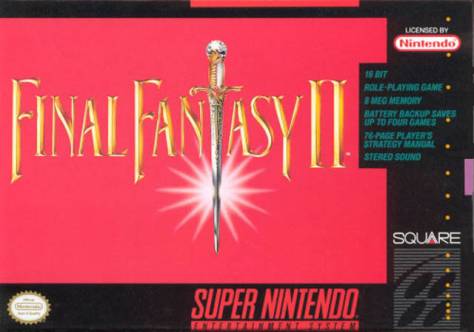
When they released it in America for the SNES a year later though, the American branch didn’t even try. It’s simple and it always catches my eye when I scour local game shops for good deals. Maybe it’s not so bad; it does catch my eye after all. They really had to pitch it to us though, didn’t they? They’ve got bullet points on the front of the box! It was released over here as Final Fantasy II since the second and third titles weren’t. This prevented much confusion. And releasing a dumbed-down version prevented much difficulty.
Back to Yoshitaka Amano.
The game was first rereleased for the PlayStation in 1997. The Japanese box art sees a return to the styling’s of Amano. Cecil Harvey and Golbez are prominently featured, although honestly, it’s hard for me to distinguish the rest of the imagery, and even if that really is Golbez and not Kain. Regardless, Kain takes his place in the logo. Cecil definitely fronted a hair metal band before being cast for FFIV. The PlayStation version was released in America too, circa 2001. It was bundled with Chrono Trigger and released as Final Fantasy Chronicles. There’s not much else to mention about the box art.
Bandai? You mean the company that collaborated on the Apple Bandai Pippin?
Little known to many Western gamers, Bandai had a fortuitous deal with Square to rerelease Final Fantasy titles for their WonderSwan and WonderSwan Color. FFIV was released for the WSC in 2002. A decadent airship is featured in the background that was no doubt crafted by the illustrious Cid Pollendina.
Simple.
FFIV would next see release on a Nintendo platform again – the Game Boy Advance. It was released as Final Fantasy IV Advance in Japan and America in December 2005, and six months later in Europe. The Japanese box art is simple. Gray silhouettes of Cecil and Kain flank the logo. Meanwhile the American and European release is much more colorful. These versions feature Cecil and Kain, as well as Rosa Farrell for the first time. The box art used for these regions hints at the love triangle between the cast. This is definitely Amano refining the “wispy lines” he’s known for.
Less simple, but I prefer it!
A few years later, the game saw a full-scale remake into 3D. Originally released for the Nintendo DS in Japan in December 2007, it was released in the back-half of 2008 in America and Europe. It has since been released for mobile devices running iOS and Android systems as well, but those platforms don’t really have boxed games… Japan received another Amano box art, featuring a larger portion of the cast, including the Lunar Whale. Here in America, we received an ominous black box, which formed a holographic Golbez. Europeans received the same essentially. The only difference was the color palette.
The DS covers.
Finally, FFIV was bundled together with Final Fantasy IV: The After Years and an interlude bridging the two titles as Final Fantasy IV: The Complete Collection. This was released for the PlayStation Portable in 2011 and was the version I played. I think Japan and Europe got the better box art with this release. A large portion of the cast is done in emotive poses, painted in a watercolor style very reminiscent of Amano’s work on the original three games in the series. America on the other hand received gray silhouettes of Cecil and Kain against a white background. This version was very reminiscent of the Japanese release of Final Fantasy IV Advance.
The PSP covers.
With a brand as strong as Final Fantasy, the box art doesn’t have to sell the game. This might explain why Square has felt the liberty to rerelease Final Fantasy IV with a multitude of different covers. With much variety for this one game, it’s hard to pick a single favorite. I really like the Japanese and European release of Final Fantasy IV: The Complete Collection. It’s probably the easy favorite. All of Amano’s artwork is awe-inspiring personally. Heck, the Super Famicom release is cool too, in a differentiated cutesy way. I’ll go with my easy favorite though – the Japanese and European releases of The Complete Collection.
On consoles, Lethal Enforcers was released in a massive cardboard box that could contain the Konami Justifier.
Back when arcades ruled the video game roost, light gun games were widespread. The genre wasn’t as ubiquitous on home consoles, but it seems like each console from back in the day had a light gun. One game with a big presence back then was Lethal Enforcers. It was originally released as an arcade game in 1992, but was ported to the Genesis, Super Nintendo, and Sega CD from 1993-1994. Developed and published by Konami, each version came bundled with the Konami Justifier, a blue light gun modeled after the Cult Python, the iconic .357 Magnum revolver. Enabling cooperative play is the harder to find pink light gun, although it works across all three platforms.
The Genesis and Sega CD versions were very grainy.
Lethal Enforcers contains little narrative, but little is needed. Crime is being committed and as a cop, it’s your (and your partner’s) duty to uphold the law. You’ll shoot through scenes in which bad guys pop their heads up from cover looking to blow yours off. Without quick timing and precise accuracy, game over comes quickly. Once those qualities are on lock-down though, you might just be able to make your city a little cleaner. While that sounded like an ad, that’s pretty much the best way I can sum up the game.
My friend and I played the Genesis and Sega CD versions of Lethal Enforcers and I only noticed one difference between the two versions – the soundtrack of the Sega CD version was of a higher quality. Both games looked identical, although the Sega CD version should look much better than its Genesis counterpart. I imagine the Super Nintendo version is identical to the Genesis version, although without playing it myself, I can’t say with certainty.
My friend and I had a rough go at the game. It was easy to complete the first level, a bank robbery, and even do so without losing lives, but to unlock the next level, we had to have 70% accuracy. We eventually managed this, but the second level, a trip to Chinatown, upped the difficulty, while also asking us to have even better accuracy. The game has five stages and I’m sure this continues to be the case throughout the game.
This scene played like an episode of The Flintstones – my friend and I saw, like, thirty National Rubber Stamp Companies.
I really enjoy light gun games, and Lethal Enforcers seems to be one of the genre’s better examples. It’s tough, but it doesn’t force players to memorize enemy locations. With quick reflexes and good accuracy, anyone can have fun. Playing cooperatively is a treat because at that point, you’re into the experience for at least thirty bucks, but it’s definitely much more fun with a partner. Lethal Enforcers is a fun game, although for the best experience, it will be slightly costly/difficult to track down. It’s worth noting that Lethal Enforcers won’t work on HDTVs so if you’re interested, make sure you have a CRT TV or something you can play it on.
It’s not every day I have a half-off coupon to my favorite video game store. So when I received one I used it wisely and picked up a relatively expensive Super Nintendo RPG. I decided on Soul Blazer, a game I had no previous knowledge of. More specifically, it was an action-RPG developed by Quintet and published by Enix for the SNES in 1992. I thought it had a simple plot and simple gameplay, but it was exciting to return life back to the world of the Freil Empire.
Primarily a tale of greed, Soul Blazer at first has a shallow plot, but it gets interesting. The king of the Freil Empire has captured a famous inventor and forced him to create a machine that allows the king to communicate with a seriously bad dude, Deathtoll. Deathtoll wants souls and the king wants money so they strike a deal, souls for money. Here’s where the player character comes in.
The player character, the soul blazer is sent down from the heavens by The Master to remedy the situation in the Freil Empire. As the soul blazer I was capable of defeating the numerous monsters throughout the dungeons of the empire as well as communicating with the souls I released.
The stages ran the gamut from sea floor to snowy mountains to space.
There were seven stages in all and I thought the way they were structured was interesting. Each stage was basically a village with access to a dungeon or two. The first stage was a mining town with a mine serving as the dungeon. The second stage was a settlement in the woods of woodland creatures, and so on; the stages were diverse and they contained all sorts of different creatures.
Like the villages, the dungeons were set in interesting locales; one on a model town and another in a fantastically rendered version of space were my favorites. The dungeons were very straightforward and not very difficult. I followed the path and killed monsters as they spawned from portals. Once the portals were depleted, they changed into a switch that would release a creature back in the village.
There wasn’t any puzzle solving in the dungeons, I just followed the path and killed any monster I came upon. The villages on the other hand did require a bit of thinking. After freeing creatures and restoring the stages to their original glory, I could chat with the creatures and sometimes get some info on a stronger sword, better armor, the location of magic, or a necessary item.
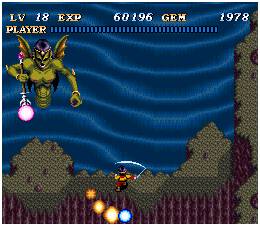
The bosses were challenging and required strafing, lots of strafing.
For the most part, Soul Blazer wasn’t very challenging. The monsters were really dumb, basically walking into my sword and the dungeons were quickly completed, about an hour for each. The bosses on the other hand were challenging, but not excessively difficult. The only puzzle solving that was tricky came at the very end when I had to retread a few of the earlier dungeons defeating previously indestructible enemies. But my favorite part of the game would have to be the soundtrack. I thought it was phenomenal and hummed along with practically every track. Soul Blazer was a good game and in the end, well worth using a half-off coupon.
Another game show video game released by GameTek, also for the SNES.
Continuing on with game show video games for the Super Nintendo, my friend and I popped in Wheel of Fortune: Deluxe Edition. It was developed by Imagitec Design and published by GameTek in 1994 and I came away with the same feelings as I did with Family Feud. It was a competent recreation of the TV show and we enjoyed playing it, but there are probably newer, better versions out there.
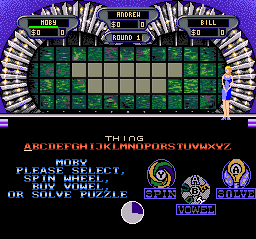
I know it!
My friend and I entered in our names and chose to be one of six characters. We played through the game in four rounds and a speed-up round, and finally the winner would play a bonus round. Like Family Feud, Wheel of Fortune: Deluxe Edition did a good job of recreating the TV show, albeit within the abilities of the SNES.
When it was our turn, we could spin the wheel, buy a vowel, or attempt to solve the puzzle. When spinning the wheel we’d land on a slot (hopefully not bankrupt or lose a turn) and then pick a consonant and win money depending on how many of that letter were in the puzzle. We could also buy vowels, and lastly attempt to solve the puzzle. If we were right, we’d win the money we had accumulated in that round. The winner after four normal rounds and the speed-up round would continue into the bonus round. Here the winner would pick three consonants and one vowel, and then attempt to guess the puzzle.
I feel practically the same about Wheel of Fortune: Deluxe Edition as I did about Family Feud on the SNES. My friend and I both had a good time playing it, but there is probably a newer, better version available.
It seems that GameTek had the market cornered when it came to game show video games in the nineties.
Having not played anything multiplayer on my Super Nintendo Entertainment System in a long time, my friend and I decided to hook it up. The first game we decided to play was Family Feud. It was developed by Imagineering and published by GameTek in 1993. The game recreated the TV show well and my friend and I had a good time playing it, but there are probably newer, better video game versions of the TV show.
After giving our families obscenity-ridden names we played the bull’s-eye round. The host asked us questions (five total, one for each family member) and we had to buzz in and guess the number one answer and whoever got it right won money. This round acted to boost our winnings, which only mattered if we wrote down the code at the end of the game to keep playing with the winning family, a neat feature.
I don't think I could name all the places that people fight over taxis.
After the bull’s-eye round, we played the main rounds of Family Feud. The host asked us a question and we had to guess what the top answers were, just like the TV show. The game continued this way until one of us had surpassed three hundred points, thereby defeating the other team and continuing into the final round, the fast money round.
In this round, two of the winning family’s members had to answer specific questions, aiming to reach a total of two hundred points, and winning the fast money round. If they didn’t crack two hundred points, they would be awarded five dollars for each point.
Family Feud on the SNES recreated the show well, but being nearly twenty years old now, it probably isn’t the ideal version to play. There wasn’t a lot going on graphically; the interface looked fine and was understandable, but the animation for the contestants was terrible. Answering required my friend and I to spell out our answer using an alphabet box, and this worked fine. We only played one game so we didn’t play through many questions, but some of the answers were not that obvious. We had a fun time playing Family Feud, chastising each other’s answers and just horsing around, and are up for playing it again.
Set in the future with a generic plot, Earth Defense Force is a quality shooter for the Super Nintendo. Lacking a thrilling story is not a knock for games of this vein as the story is each person’s experience encountering the hundreds of enemies and bosses you’ll surely take out. From the beginning, the game is fast paced and early on, requires quick reflexes as well as memorization.
EDF was developed and published by Jaleco; it was released originally into the arcades and later ported to the SNES. Having never played the arcade version I’m unaware of the differences between the two. The story of EDF is told in the manual with a lack of cutscenes or any background in-game. I would’ve liked seeing some sort of progression between levels but the story in the manual was sufficient for the genre. Full disclosure: I wasn’t able to beat the final boss and see if there was an ending sequence. That being said the manual was detailed and even referenced The Beatles!
At the beginning and between each level you are given the option to pick a weapon type. There are eight different types but a few seem redundant. My favorites were the homing and the search laser although anyone who has played a
The homing weapon in action.
similar game will find something familiar. As you defeat enemies you will fill a bar at the top of the screen. This will level up from 1-5, each time increasing the power of your weapons. This turned out to be a good barometer of success and a way to differentiate itself while retaining elements of the genre. Flying with you are two satellites ships that provide extra firepower. As you level up, they’ll be able to take on different formations and like your weapons, become more powerful. These smaller ships are indestructible and can absorb some enemy fire.
The game is comprised of six levels that take you from Earth to space and get increasingly more difficult. I spent much time getting to a new part and dying, but making progress with each death until I was able to get to the final boss. Though all this dying was frustrating at first, it came to be a part if the game. I found the game to be tough, but fair in most parts and towards the end of my playing I was able to reach the final boss without losing a life. The final boss however seems very cheap, nigh impossible. This experience is made worse when you lose all of your continues and must trek through the whole game just to have another stab at him, all a part of the game I suppose. I felt the soundtrack was great; its up-tempo beat matched the nature of the game and in particular I found the weapon select track superb.
I found the final boss just too tough to continue after a while and have given up on the game. I will still try every now and then and I won’t let this bad ending impact my view of an otherwise solid game. I found EDF to be fast paced and when considering the effort it took to be able to get to the final boss undefeated, rewarding.
Share this:
Twitter
Facebook
Tumblr
Like this:
LikeLoading...
The internet's source for Mansion of Hidden Souls.
![EarthBound [Super Nintendo] – Review](https://mybrainongames.files.wordpress.com/2020/07/earthbound-super-nintendo-north-american-box-art.jpg?w=672&h=372&crop=1)

![Arkanoid: Doh It Again [SNES] – Review](https://mybrainongames.files.wordpress.com/2014/08/arkanoid-doh-it-again.jpg?w=672&h=372&crop=1)
 My interest in the Arkanoid series piqued after reading a Retro Gamer article chronicling the series. I’d never played a game in the series, although like most everyone else, had played a game like it. So, when the Oklahoma Video Game Exhibition came around and I found what I believed to be a reasonably-priced complete copy of Arkanoid: Doh It Again, I snagged it. Since then, I’ve played the game a great deal, enough to beat it, even. There were interesting touches to differentiate it from other similar games, although I eventually grew bored of it. The bulk of my time was enjoyable, but the times that weren’t, were tortuous.









 My Brain on Games