You know, I still remember checking out Castlevania on the NES in the early-to-mid 2000s, marveling at the foundations of the series that spawned one of my favorite games at the time, Castlevania: Aria of Sorrow. This had to have been late in my middle school years, perhaps even my first year of high school. I had already been turned onto video games for a year or so, and not too long before I had scored an incredible haul from a garage sale that furthered my interests in retro gaming. It was a NES with, like, all the heavy hitters. I’m talking multiple Super Mario Bros. and Zelda games, Metroid, Contra, the Zapper, and of course, Castlevania. What stuck with me most about checking out Castlevania was its difficulty. I could only get so far – maybe the second boss – before burning out and throwing in the towel.
Fast forward to Halloween afternoon, 2021 and I STILL hadn’t played a thematically appropriate game for the month of October. As one does with scary stories, horror movies, and the like, there’s just something fitting about consuming them in October. At least here in North America, fall is starting to FEEL like fall. It’s getting darker earlier and colder, which makes it harder to enjoy physical activities outdoors, and on top of that, everything’s dying. Why not revel or find solace in a piece of entertainment that mirrors the increasingly dire situation that surrounds oneself? Well after days of seeing Philip Summers – aka “The Hand-Drawn Game Guides guy” – post about his Castlevania exploits on Twitter, I decided I’d do the same!
I concluded my review of Suikoden II stating that “It’s tale of war, viewed from macro and micro perspectives, was better executed than its predecessor, and one that I’ll inevitably judge its successors upon.” Well, the rubber meets the road now that I’ve completed Suikoden III.
Suikoden II lives up to the hype. Having heard its praises sung for years, I’ve long been interested in playing it, and the series as a whole. The recent announcement of a spiritual successor reignited my desire to jump in, and I found the first game quite enjoyable. Suikoden II though, is an improvement in almost every regard. Like its predecessor, the developers adapted gameplay systems and formulas common to traditional Japanese role-playing games – think turn-based battles and town-dungeon-town progression – but did so with their own twist.
If you could glean anything from my Kickstarter pledge history, it’s that I’m fond of video games. A closer inspection would reveal a narrower common thread: I’m especially fond of Japanese video games! Following a string of high profile campaigns in 2012, the crowdfunding site saw its legitimacy grow in the industry. In the years since, a number of well known Japanese designers have turned to it to revitalize the types of games they once made, such as Keiji Inafune with Mighty No. 9, or Koji Igarashi with Bloodstained: Ritual of the Night. The latter is still on my backlog, and from all accounts is a worthy successor the Castlevania series while Mighty No. 9… well, the less said about it, the better. In a similar vein, Yu Suzuki was able to bring Shenmue III to fruition, which I loved! And that’s probably the most important aspect of these campaigns in particular: they’re reviving something beloved, that’s been absent for one reason or another. Well, as of August 29, 2020, there’s one more project can be added to that list: Eiyuden Chronicle: Hundred Heroes.
When a friend and I beat Kirby’s Epic Yarn about a month ago, the decision on what we’d play next was pretty easy. Kirby’s Epic Yarn was a relatively simple side-scrolling platformer with enjoyable co-operative gameplay, some inventive stages, and an incredible design aesthetic. It was a game that just emanated happiness. Yeah, we wanted more of that. And so, we tracked down a copy of Yoshi’s Woolly World, the spiritual successor to Kirby’s Epic Yarn. Structurally, the two games weren’t awfully different, and mechanically, the stars in both functioned similarly. But the abilities unique to Yoshi, namely tossing eggs, allowed for a broader range of platforming challenges and additional ways to interact within stages; it was slightly tougher, and more engaging. These considerations, in partnership with the remarkable art design, resonated with me; Yoshi’s Woolly World was an outstanding video game! Continue reading Yoshi’s Woolly World [Wii U] – Review→
In the lead up to my recent week of vacation, I planned out a few things I wanted to accomplish. Top of the list was getting some car repairs done. I also wanted to spend at least one day with my wife driving around a nearby Oklahoma county, hunting for historical markers and eating local BBQ. There were a few odds and ends to be done around the house as well but when it came to video games, I had only one objective: begin, and hopefully complete, Bloodstained: Ritual of the Night. That didn’t happen, but before I even started compiling my to-do list I was already preparing a contingency plan. Continue reading Castlevania: Order of Ecclesia [Nintendo DS] – Review→
Now this is my kind of game! Available for both iOS and Android devices, Pixel Puzzle Collection merges Picross style gameplay with trivia on Konami games of the past, classic and lesser-known titles alike. It’s free to boot, and even though it’s chock-a-block of ads, they’re minimally invasive.
It’s been about a month since Jeff and I completed Metal Gear Solid 2: Sons of Liberty. Generally, I try and write about a game within a few days of completing it but this game wound up provoking so many mixed emotions for me. It’s left me awestricken in many ways, some good and some bad. This is a game that’s often touted as the first postmodern video game, and while I’m too much of a dullard to fully comprehend this statement, the way my own opinion has been split in so many ways is indicative of its provocative nature. It’s a game I admire and disdain at the same time, and I’ll try my best to detail some of the major reasons why.
Stealthily eliminating foes was the way to go.
Like our recent playthrough of Metal Gear Solid, this wasn’t my first experience with this game. I originally played it a couple of years after its release and recall thinking the world of it then. As a sequel, the narrative subverts most preconceived notions of what to expect, and I think high school John really got a kick out of that. As an adult, I still find that fascinating, perhaps more so now, especially having directly completed its predecessor. One of the most notable ways Kojima did this was through a bait-and-switch of the protagonist.
While the first hour or so of the game stars Solid Snake, as one would expect, the true star of the game is Raiden. As a character, he’s anything like Solid Snake, the gruff, self-assured action-movie hero one expects in a game like this. Instead, Raiden is supposed to represent the player, a novice whose preparations for the big time constituted training in virtual reality. These preparations leave him undoubtedly skilled, but not with a mindset capable of being successful in the ways Solid Snake has been previously. His lack of confidence was grating to witness, although his character arc climaxed with my impression of him notching up a little bit.
The story of Metal Gear Solid may have grown convoluted but it doesn’t hold a candle to anything on display here. At its most basic, this game centers on Snake and Otacon’s quest for Metal Gear nonproliferation and Raiden’s journey to discover himself. Then about a dozen layers are added on top of those and any further comprehension requires extensive notetaking and periods of downtime to digest the events of the lengthy and frequent cutscenes. The breakdown between actually playing the game and watching it was somewhat jarring, although I did enjoy watching more than playing. Maybe I feel that way because the time I had to develop my stealth and combat skills was squashed between lengthy conversations that took me out of the experience? Either way, I felt my performance was less impressive compared to the previous game.
Due to narrative reasons that are mind-blowing, the events of the game are purposefully similar to the Shadow Moses Incident and wind up serving as little more than a test to creating a solider equal to Solid Snake. Pulling the strings is a shadow organization known as the Patriots. Already in control of the United States (every election has been a sham and most major government officials are representatives of the organization) they’re seeking control of the flow of digital information now. A new Metal Gear was designed and the AI contained within, GW, is the construct to achieve their goal. There are about another dozen crucial characters and their allegiances and double crosses become confusing narrative fodder. Thankfully I did take detailed notes but even so, I remain unclear on many things and feel another playthrough is necessary to really comprehend everything. Nonetheless, the narrative was the freshest aspect of this game and it was unpredictable at every point.
Raiden was a tough character to like.
Likewise, the depth found in the gameplay has also been drastically increased. The increased AI is no joke; no longer do guards make buffoonish decisions when catching a glimpse of Snake in a box. Rather, they call reinforcements more often than not and send in additional soldiers to “clear” an area, searching in most nooks and crannies. It felt like setting off an alert resulted in many more mission failed screens compared to the previous game. I want to say in addition to the more stringent AI, the alerts lasted longer too. Frequently, I would throw Raiden or Snake in the line of fire just to get a quick reset instead of hiding for the few minutes it would take for things to cool down. This resulted in a less enjoyable gameplay experience. It’s also one of the reasons I’d like to replay the game again, just to take my time and devote all my focus to remaining stealthy and see if my performance and enjoyment increase.
The gameplay improvements are not relegated solely to stealth actions. Gunplay received an overhaul in the form of first-person shooting. First-person shooting provided a greater level of accuracy when eliminating enemy threats, and provided some fun when taking them by surprise. Individual body parts could be targeted, including the ability to shoot the radios an enemy may call for reinforcements with. This viewpoint was only useful in specific cases though as the character would remain locked in position – the game couldn’t be entirely played like a first-person shooter. It was a smart addition nonetheless and added a further layer of complexity to approaching a situation.
With first-person shooting, the level of precision allowed increased immensely. Shooting soldiers, or glass bottles, in specific locations yielded different outcomes.
Like its predecessor, there were many great set piece scenes with most of them revolving around the varied boss fights. Again, there was a rogues’ gallery of bad guys to defeat and each encounter was a unique experience. I can’t think of any being down-to-earth showdowns; for instance, Raiden battling a roller-skating mad bomber of sorts or his showdown with a small force of towering Metal Gears. The set pieces extended beyond cinematic fights though, including one particularly frustrating platforming section. One section in particular ate our lunch, seeing us retry twenty or so times. Raiden was forced to navigate a narrow strip of piping across a body of water and the various obstacles highlighted why such a section didn’t jive with the super responsive character movements.
By the end of the game, Raiden had been redeemed in my eyes, proving he could hang tough.
What do I think of this game? The narrative is bold, but tough to follow. I want to replay and reread my notes to try and piece everything together. I didn’t much care for Raiden although I felt he was redeemed by the end; for a deeper analysis that I agree with (and reasoning why this game is postmodern), read this. The gameplay split my opinion the most. I like the improvements, even though the increased AI resulted in a tougher game with more frustrations. Again, it’s another reason I’d like to replay, in order to have a more enjoyable experience. As it stands, it was enjoyable seeing what happened in the game, less so to actually play. I still think the original is unsurpassed as a pure video game or piece of entertainment. I would agree that this game is incredibly bold and deserves most every ounce of praise; it just wasn’t as fun to play.
The desire needed to complete Metal Gear Solid: VR Missions must be strong in order to persist through the game’s 300 missions. As the name suggests, these missions are set in virtual reality and act as a simulation, presumably for Raiden – the “star” of Metal Gear Solid 2: Sons of Liberty. They put him in the shoes of Solid Snake in a variety of challenges that test his stealth skills, weapon proficiency, as well as some others that are just for fun. There is a great variety of missions and I became intimately acquainted with each weapon and the fundamentals of the stealth gameplay. However, there isn’t a great sense of diversity in the missions. Many repeat and there just aren’t enough unique or goofy missions to warrant the time required, especially as there’s little that adds to the lore. But, I did wind up with a 100% completion rate and eked plenty of enjoyment out of my time with the game.
The majority of the missions had a wireframe visual style.
Of the four modes the game is divided into, I had the most fun with the final one: special. To unlock it and its various subtypes, I had to work my way through the other three modes: sneaking, weapon, and advanced. Sneaking mode tasked me with just that: being stealthy. To promote this, half of the missions supplied me with no weapons while the other half limited me to Solid Snake’s trusty SOCOM firearm. This forced me away from just mowing down enemy resistance, although this isn’t a tenable strategy most of the times anyway. I was also required to complete these missions a second time in time attack versions. They were identical, only now I was racing against the clock. I got my fill, but wasn’t burned out.
The subsequent two modes played out a little differently. The first, weapon mode, equipped me with a single weapon for a series of increasingly tougher missions. Time attack versions were also present meaning I repeated each mission twice. All in all, these weren’t very challenging even at their toughest, perhaps explaining the need for the advanced mode. The setup was the same: a few missions with only a single weapon type equipped putting Solid Snake in a more precarious scenario. Again, time attack versions meant I had to repeat these stages twice. At this point, the struggle to continue playing got real.
Missions revolving around Solid Snake’s arsenal were the most common.
Stripped of a grandiose narrative, VR Missions is solely gameplay driven. In the presentation, it’s practically a puzzle game. It’s loaded to the brim with mostly succinct missions that hone in on one or two facets of the gameplay. For the most part, they’re enjoyable and enlightening – I know I can return to Metal Gear Solid with a more confident understanding of Solid Snake’s arsenal and the stealth options at his disposal, if I wanted to, which I don’t. I came to this title not knowing what to expect necessarily and it really comes off as what it’s portraying – a training tool. Just as much of training is based around repetition, so too is this game and that’s where it became a struggle to persevere. Many of the mission types were very similar, but then having to repeat the bulk of them in a time attack version? That was a real buzzkill.
When I made it through the majority of the game and unlocked the various mission subtypes within the special mode, I was a little disappointed. There were still plenty of rote simulation style missions among the scant goofy mystery and puzzle style missions. Granted, I got to solve murder mysteries, fight off UFOs and skyscraper-sized enemies, and play as Cyborg Ninja, but this off kilter style of mission was less abundant than I had hoped for. Even with these goofy scenarios, the highlight of this mode was perhaps the final mission I tackled: the VR mission. To clear it, I had to make my way through a truly challenging ten stage gauntlet within a fifteen minute time span, which was always tallying time, even factoring in restarts and deaths. It took me a few attempts before I could do it but when I conquered it, excelsior! It honestly forced me to use much of what I’d learned up to this point to succeed.
A camera mode was one of the unlockables, and very underwhelming.
Afterwards I got a schematic for Metal Gear Ray, to be featured in the then-unreleased sequel. Again, I was a little disappointed after a dozen hours and a 100% rating for that to be the reward. That’s not to say I didn’t have fun, the game simply grew tiring. There were loads of exciting missions and a lot of variety in the scenarios I was put in and what the missions tasked me with. Unfortunately, many of these had to be repeated which stripped the time spent of diversity as I was repeating much of the game twice. It comes off as a hard game to recommend to anyone but the most diehard fans of the series, and even then I’d caution against playing the time attack versions until all unplayed missions have been exhausted. That should extend the enjoyment and reduce the sense of repetition that I encountered in my time with the game.
When I talked about Fallout Shelter last week, I began by considering it in a vacuum. Without partners playing too, it grew to resemble a chore more than an enjoyable escape. I feel like taking the same approach with Castlevania: Portrait of Ruin but for a different reason. In a vacuum, this game is practically the pinnacle of the 2D action-adventure genre. The addictive blend of action, exploration, and role-playing elements that the series is known for, still make up the core experience of this game and pair well with new additions. Level design remains fresh throughout, in part due to the top-notch audio/visual qualities and varied surroundings. The reasons to continue playing after completion are immense as well, but, this is like the fifth Castlevania of this style I’ve played, and while they’re individually superb, they elicit less exhilaration after each completion.
Per usual, the animation was top-notch.
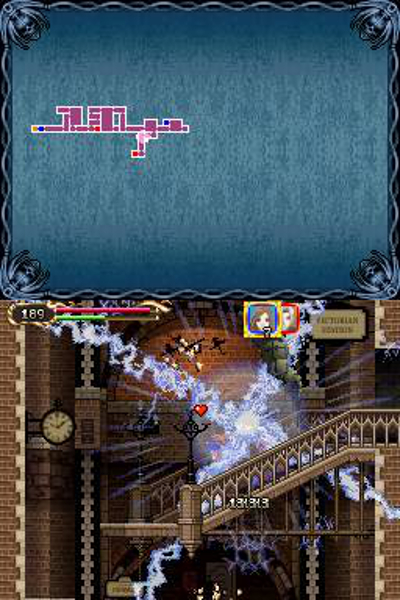
When it was released for the Nintendo DS in late 2006, Portrait of Ruin was joining an already extensive collection of similar Castlevania titles that had released relatively recently. Koji Igarashi and his crew at Konami differentiated this game in a few ways, most notably, by focusing on two characters instead of one. The plot centers on Jonathan Morris’ quest to quell Dracula’s uprising amidst a war-torn Europe circa 1944 with his partner Charlotte Audin. He resembles the typical Castlevania protagonist in many ways while she is a spell caster with a growing repertoire of spells, another series staple.
I could freely switch between the two at all times and this allowed me to dabble with both combat styles – weapons with him and magic with her. These two styles were vastly different in execution and perhaps because of my familiarity with previous entries, I stuck with Jonathan. When not actively controlled, the partner was still useful. They would automatically attack on-screen enemies, albeit with little intelligence. This was beneficial in dealing with enemies but it proved most worthwhile in drawing enemy aggression towards the partner, allowing me to attack from behind. Outside of combat, the duo was put to use in progressing past a few (generally half-assed) puzzles. The most memorable of these had both characters riding motorcycles and tasked me with switching between them in order to make sure neither was knocked off by various obstacles. It was a fast-paced puzzle that made me stop and think of a viable solution, unlike most others.
The game had a limited number of NPCs, but each was integral to the plot.
Additionally, the game was distinguished by the variety of locales Jonathan and Charlotte traversed. Now, the primary setting was Dracula’s Castle (naturally) but much of the duo’s time was spent exploring the paintings strewn about, a la Super Mario 64. In keeping with the series, these maintained a gothic design. They transported the pair to the streets of a bombed-out European city, a nightmarish circus, and many more unique backdrops that would’ve seemed out of place as disparate areas of the abominable abode. The series has always attempted to segregate Dracula’s Castle with diverse milieus but this is the best example I’ve seen.
Although Jonathan’s quest was to banish Dracula’s Castle, that vile vampire wasn’t an issue until late in the game. While the castle had arisen because of the agony and hatred within humanity during this period, another vampire took advantage of the castle’s powers for his own agenda and prevented Dracula from reviving. That vampire, Brauner, ultimately worked towards the same end goal of humanity’s destruction, but did so out of the hatred he felt for losing his daughters during the First World War. Brauner was able to harness the power of Dracula’s Castle through his paintings. With assistance from newfound friends and through the evolution of a subplot or two, Jonathan and Charlotte were successful in cleansing the castle of Brauner’s influence and ultimately dealing with Dracula and his ilk.
Some sections of Dracula’s Castle may look familiar to veterans of the series.
There were plenty of reasons to keep going once the story was finished too. Exploration and the mapping of Dracula’s Castle has been a core component of the series since Symphony of the Night, and this game doesn’t disappoint with its 1,000% MAP COMPLETION RATE! That number is perhaps artificially high because of the multitude of paintings, but there is a lot to explore nonetheless. Moreover, there were many collections to complete such as obtaining all items or filling out the bestiary and mastering each sub-weapon, powering them up in the process. These are customary features for the series but also available were sidequests from one of the duo’s associates. I believe this was a first for the series and I had completed maybe 15% at game’s end after passively trying, so there’s much to do on that front.
Two more sets of playable characters could also be unlocked and both changed gameplay dramatically. The environment remained the same with both but the equipment and magic customization was backpedaled completely and a story was basically nonexistent. One pair of characters was a throwback to the classic days of the series with a focus on sub-weapons and the legendary whip, Vampire Killer. This duo was overpowered and playing with them felt like I was in “God mode.” The other duo utilized the touch-screen exclusively. The touch-screen was integrated into the game elsewhere but I literally never used it. The execution with these two was actually very intriguing and their individual means of attacking required different touch-based actions. A Boss Rush mode was also available after completion as well as a co-operative mode (multi-card only).
The duo had access to super-powerful co-op attacks that drained their MP.
Castlevania: Portrait of Ruin has all the staples I’ve come to expect from the series as well as a few differentiating features. The core of these, a focus on two characters, helped to freshen the formula but it was probably the variety of settings that kept me most entertained. Not to mention the accoutrement found in the various collections to complete, sidequests to beat, and unlockables to try out after the plot had wrapped up. The more modern backdrop and the twist on the classic premise were appreciated as well. I think this is probably the most complete Castlevania I’ve played of this style, but I don’t think it tops Aria of Sorrow for me. That was my first foray into the series and each one I’ve played since has been chasing that experience. They’ve all been outstanding, but like the saying goes, I’ll never forget my first, and I’ll forever be comparing successive entries to it.
Share this:
Twitter
Facebook
Tumblr
Like this:
LikeLoading...
The internet's source for Mansion of Hidden Souls.
![Castlevania [NES] – Review](https://mybrainongames.files.wordpress.com/2014/12/castlevania.jpg?w=672&h=372&crop=1)

![Suikoden III [PlayStation 2] – Review](https://mybrainongames.files.wordpress.com/2021/11/suikoden-iii-playstation-2-north-american-box-art.jpg?w=672&h=372&crop=1)

![Suikoden II [PlayStation] – Review](https://mybrainongames.files.wordpress.com/2020/12/suikoden-ii-playstation-north-american-box-art.jpg?w=672&h=372&crop=1)

![Suikoden [PlayStation] – Review](https://mybrainongames.files.wordpress.com/2020/09/suikoden-playstation-north-american-box-art.jpg?w=672&h=372&crop=1)

![Yoshi’s Woolly World [Wii U] – Review](https://mybrainongames.files.wordpress.com/2020/07/yoshis-woolly-world-wii-u-north-american-box-art.jpg?w=672&h=372&crop=1)

![Castlevania: Order of Ecclesia [Nintendo DS] – Review](https://mybrainongames.files.wordpress.com/2019/07/castlevania-order-of-ecclesia-nintendo-ds-north-american-box-art.jpg?w=672&h=372&crop=1)

![Pixel Puzzle Collection [Android] – Review](https://mybrainongames.files.wordpress.com/2018/12/Pixel-Puzzle-Collection.jpg?w=672&h=372&crop=1)

![Metal Gear Solid 2: Sons of Liberty [PlayStation 2] – Review](https://mybrainongames.files.wordpress.com/2015/11/metal-gear-solid-2-sons-of-liberty.jpg?w=672&h=372&crop=1)


![Metal Gear Solid: VR Missions [PlayStation] – Review](https://mybrainongames.files.wordpress.com/2015/10/metal-gear-solid-vr-missions.jpg?w=672&h=372&crop=1)


![Castlevania: Portrait of Ruin [Nintendo DS] – Review](https://mybrainongames.files.wordpress.com/2015/09/castlevania-portrait-of-ruin.jpg?w=672&h=372&crop=1)


 My Brain on Games