While SteamWorld Dig is the second entry in a versatile series of steampunk video games, it was the first that caught my attention. In part, because it has appeared on every major platform since in debuted on the Nintendo 3DS in August 2013; and for good reason, it turns out. The mining gameplay bears a resemblance to the classic Namco games Dig Dug and Mr. Driller, but Gothenburg, Sweden-based Image & Form Games were able to carve out a unique identity for SteamWorld Dig by elaborating upon the basic gameplay foundations introduced in those games. Continue reading SteamWorld Dig [Nintendo 3DS] – Review→
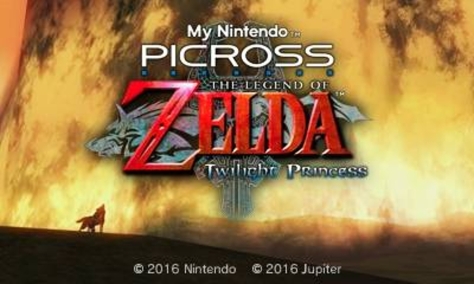
The demise of Club Nintendo, the decade-old loyalty program, was a sad moment for fans of the Big N. It’s made worse by the fact that the successor program, My Nintendo, offers chintzy rewards and a distinct lack of physical products. Well, save for one. As Stephen Totilo highlighted in a recent Kotaku article, My Nintendo Picross: The Legend of Zelda: Twilight Princess, a digital 3DS game, is available to those who have accrued 1,000 Platinum Points through My Nintendo. In his story, he articulated the simple, yet tedious process, of earning these points. Seeing as I’m such a big sucker for both Nintendo and Picross, I followed his lead and got the “free” game. Continue reading My Nintendo Picross: The Legend of Zelda: Twilight Princess [Nintendo 3DS] – Review→
I had my first hands-on experience with mahjong a few months ago with Shanghai on the Sega Master System. Having enjoyed it, I scoured my collection for another mahjong game and came across Mahjong Cub3d for the Nintendo 3DS. Developed by Sunsoft and published in the United States by Atlus on October 11, 2011, it’s a Picross 3D styled adaptation of solitaire mahjong. I enjoyed clearing 3D mahjong piles despite a perplexing lack of touch screen controls. When I wanted something more traditional I attempted to solve deviously difficult standard mahjong puzzles. Now that I’ve played this a while, I believe my hunger for mahjong has been filled. Continue reading Mahjong Cub3d [Nintendo 3DS] – Review→
Gunman Clive has been installed on my 3DS since acquiring it in the first Nintendo Humble Bundle back in May 2015. It released on the eShop in December 2012 and I remember thinking it looked promising then, especially for the couple of dollars Hörberg Productions was asking for it. Nonetheless, I skipped over it every time I turned on my 3DS until yesterday. Searching for something I hadn’t played and preferably a game I’d be able to complete in a brief amount of time, Gunman Clive immediately came to mind. It satisfied both objectives and was a distinctive platformer in the vein of the NES-era Mega Man games. Continue reading Gunman Clive [3DS eShop] – Review→
When Nintendo of America announced they had localized and released Picross 3D: Round 2 a year after its Japanese debut, I was over the moon. The Picross series has been a stable time sink for me ever since I first played Picross DS. However, I was a little dismayed that it wasn’t destined to receive a physical release in the west. No, it was only available digitally and I’m one of those weirdos who’s reticent to purchase nonphysical copies of games, convenience be damned. Seeing as I didn’t have a reasonable option for a physical purchase, I willingly plunked in my credit card information and made the purchase. I’m glad I did.
After spending three hours with Pokémon Dream Radar, I can thoroughly report that it more closely resembles a tech demo than a video game. And if spending that much time with a glorified tech demo doesn’t sound appealing, hopefully the prospect of receiving a handful of legendary Pokémon does, because that’s the true purpose of this product. It plays almost entirely with the Nintendo 3DS’ augmented reality functions, tasking players with collecting orbs and catching Pokémon using the forward-facing camera of the handheld. It’s a novel prospect for the first few rounds but it quickly becomes clear that’s all it is: a novelty. Regardless of my Pokémon fandom, the hours I spent playing this purchasable object resulted in little more than a dreadfully boring grind… and legendary Pokémon. Continue reading Pokemon Dream Radar [3DS eShop] – Review→
Roaming Pokémon are the worst. I’ve been nearing the end of my Pokémon Y playthrough and just gained access to one of the few available legendary Pokémon. Unlike the few others that are located in caves, this particular one roams the region. It’s such a pain in the ass to catch though I don’t know that I’ll even put in the time to obtain it. This isn’t a new concept for the series but it is one rarely utilized. I’m generally not one to play armchair quarterback but as my frustration grew Sunday morning, I thought about what I’d do to improve upon the concept. It’s one I theoretically like, especially applied to the Pokémon games, I just wish it was implemented differently in this instance.
If actively pursuing a roaming Pokemon, this screen will be seen often.
In the Pokémon games, beating the Elite Four and champion is one of the core goals; doing so signals that you’re the strongest trainer in the region. Afterwards, there’s additional content that becomes available. It’s generally not much but in Pokémon X and Y, it seems especially barren. Regarding X and Y, every player’s first encounter with a wild Pokémon in the post-game will always be with one of the legendary birds. It’s different based on which starter Pokémon was picked at the beginning of the game. Since I picked Froakie, the legendary Pokémon available to me was Moltres.
This first encounter is just a tease as the Pokémon immediately flees. Now however, the Pokémon’s entry has been somewhat completed in the Pokédex, at least enough to track it and see where it’s currently located. At this point, there’s primarily two ways to tackle this capture: passively try to catch it as the post-game content is naturally completed or while focusing on other objectives, or actively try to pursue it. Since there’s not a ton of post-game content and I’m merely “passing through” this game on my way to Omega Ruby, I actively tried catching it.
The method of actively pursuing a roaming Pokémon I’m most familiar with entails going back and forth between two routes or a route and a town in the hopes that it will appear in the desired route. This becomes a tedious task quickly as the player buttons through layers of menus to get to the Pokédex to locate if the Pokémon is nearby. If it isn’t, cross that border and back into the desired route and check again. Luck is a factor in the sense that it’s rarely on the player’s side when tracking roaming Pokémon. And, something as simple as flying to where the roaming Pokémon is won’t work as it will be somewhere else by the time the player touches down.
If that Pokémon is on the current route, the player can still mess up their opportunity to encounter it. For instance, if the first Pokémon of the player’s party is of a higher level, the roaming Pokémon won’t appear. In fact, if you encounter another Pokémon, say a wild Flabébé 70 levels the junior to the first Pokémon in the player’s party, that roaming Pokémon is now somewhere else. The so-called legendary is afraid to fight something a piddly wild Pokémon will gladly step up to. WHAT!? Even if a weak Pokémon is in the first spot of the party and the roaming Pokémon is in the current route, there’s still no guarantee that it’ll be encountered. And if a wild Pokémon is encountered instead, that roaming Pokémon is likely somewhere else.
It can be frustrating and at the very least, time consuming. The roaming Pokémon in X and Y eventually settles down in a cave after ten encounters. But still, that’s ten encounters when I’ve had trouble getting a second! So, what would I do differently? One implementation stuck out to me immediately and it’s primarily what I’ll posit. There’s plenty of ways to alter this concept too but it’s only now that I’m shifting gears towards constructive criticism that I realize I really just wanted to rant. Still, I’ll elaborate on a different method of including roaming Pokémon that may be less frustrating than the current one.
First off, instead of introducing the roaming Pokémon after the game’s been beaten, I’d instead introduce it during the lead up. I’m of two minds on how to: randomly or through a predetermined encounter. Introducing it through a random encounter would mean a different experience for every player. For some, it may be the first wild Pokémon they encounter; others may not see it at all during their playthrough. This randomness would make the encounter more impactful, like running across a shiny Pokémon, although I’d want the chance of seeing it much higher than seeing a shiny Pokémon (roughly 1/4096 for the current generation). Perhaps the best method would be through a predetermined encounter, with future appearances requiring the hunt; basically just changing the timing of the Pokémon’s initial availability.
The legendary Pokémon almost always appear at a preset level which could break the game’s difficulty if one was encountered early on and somehow caught. They could instead have a scalable level based on when they’re encountered. I’d scale it such that it can still wallop the player’s party but a skilled player may be able to inflict a status condition or throw a Poké Ball. That would entail allowing the player to get a move off whereas currently, the Pokémon flees before the menus on the touch screen even appear. I’ve caught legendary Pokémon by throwing a Poké Ball out as my first move and let me tell you, it’s pretty satisfying!
How I longed to have this happen.
As I thought, I wound up wanting to rant more than to offer constructive advice. At least, offering detailed constructive advice because really, simply introducing the roaming Pokémon sooner would alleviate a lot of my grief. With my current chase, I feel like actively pursuing Moltres is the only option since there’s so little post-game content. If I was sticking with this game longer, this whole topic would be a moot point. I’ve already got Omega Ruby queued up and if I’m going to spend dozens of hours with a game to complete the Pokédex, it’ll likely be that one since it’s the most recent release. As it stands, tracking this Pokémon down and attempting to catch it is a pain in my ass and likely one I won’t continue to endure.
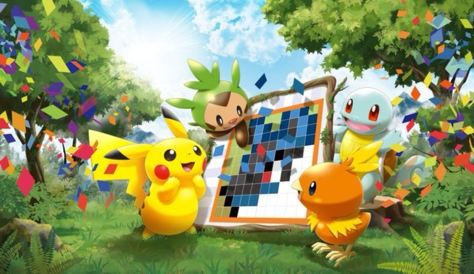
I’m disappointed with Pokémon Picross. Or rather, I’m disappointed in my expectations for the game. When it was announced in a recent Nintendo Direct, it was fully detailed as a “free-to-start” title: a game I’d be able to download and play for free. Presumably, there’d be some reason to coerce me to input money, but I didn’t ruminate on that or the potential pitfalls associated with the game’s payment model further. My lust for a new Picross game caused blinders to go up, especially considering this was a new one thematically designed around Pokémon. A peanut butter and jelly combination if I’d ever heard one! Having spent some time with the game, I’ve come back down and am firmly grounded in reality.
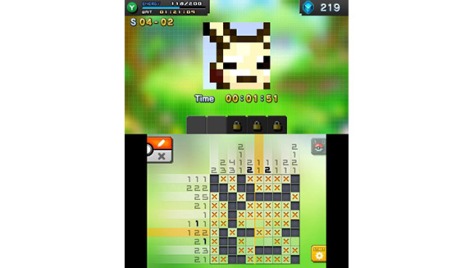
Nintendo’s Picross games are logic-based puzzlers that task players with filling in a gridded square using numerical hints on each row and column, ultimately revealing a picture. The numbers bordering each row and column indicate how many squares are to be filled in and if they’re connected or contain an unknown space of unmarked squares between them. Using deductive reasoning, one can determine that if a row of 10 squares has a hint of 8, a certain number of squares must be filled in, regardless of where the filled in section begins and ends. Extrapolating this thinking across the entire grid and utilizing squares that have already been filled in is an addictive process with a satisfying sense of completion when complete, especially on the larger puzzles.
Pokémon Picross takes that standard concept and applies some of the mechanics from the Pokémon series. The puzzles themselves are representative of individual Pokémon that when complete, result in catching said creature. They each have an ability that aids in the completion of puzzles by filling in squares, slowing time, etc. This mechanic ties into another new addition, rewards for completing specific objectives for each puzzle. Each puzzle has a set of unique objectives, such as set Pokémon X or use ability Y. Rewards for completing these were generally Picrites, the in-game currency.
A Pikachu puzzle in progress, nearly there!
Mega Puzzles make a return after their debut in the digital only Picross e titles, although they’re completely foreign to me. I skipped out on those digital titles not thinking they contained much content (I was wrong, rectifying that mistake… now) but they make total sense in a Pokémon themed game, considering Mega Evolutions are the new “thing” for that series. Basically, they screw with the hints given and instead combine two rows/columns. Even after going through the tutorial a time or two, I had to wrack my brain to comprehend them. They add a nice change of pace, but are nowhere near as progressive as Picross 3D.
Progression is also portrayed differently, although is structurally similar to previous Picross games. Players navigate the game from puzzle to puzzle as if navigating the varying routes in a Pokémon game, complete with branching paths and different creatures. The difficulty pacing is all over the place, which for a veteran like me is appreciated. While it could be a hindrance for someone unfamiliar with the series (and I could see many newcomers coming for the Pokémon side of the equation), it also further replicates the progression of a standard Pokémon game, e.g. having to return to some cave with stronger Pokémon. Reaching new areas is no small feat and the barriers are twofold: energy and Picrites.
And the completed puzzle results in a new Pokemon added to the collection.
I originally wanted to start this section off discussing one of these mechanics as the lesser of two evils, but they’re both pretty mischievous, but ultimately boil down to one annoyance. Like many free-to-play games, this one utilizes an energy meter. As squares of puzzles are filled in, that meter depletes until it’s empty, halting progress until it’s refilled. The easiest way is to wait for it to refill; this can take a couple of hours and for the player in need of a fix, the quickest way is to refill it (or extend it altogether) with Picrites. As mentioned, Picrites are the in-game currency and are awarded for the completion of puzzles and the completion of objectives. They are doled out in laughable quantities in relation to the amount needed to unlock additional areas and upgrades, heck even an alternate set of puzzles are gated behind a hefty sum of Picrites. The only logical solution is to pony up real money.
This is a free-to-play game (and the core game is damn fine!) but convincing myself to plug in more than a couple of bucks is a tough sell. Admittedly, I’m still one of those luddites who prefer physical media and getting something I can hold in my hands in return. And I understand that many individuals worked on this game and there are plenty of stakeholders who deserve a cut. But, the portrayal of this game as free-to-play is somewhat devious. The amount of Picrites awarded in relation to the tally needed to unlock additional stages is prohibitively high and at some point, progression is gated behind a measly few puzzles that can be farmed each day.
Labels and payment models shouldn’t conjure this much ill will, and I’m perhaps going overboard here, but I would’ve rather seen Nintendo strip away the free-to-play elements and just market a full-price digital title. Obviously they didn’t go that route and I’m sure there’s plenty of evidence to suggest they’d reach more players, and ultimately yield more revenue by adopting the model they went with. And with that “realization” this article has devolved into a codgerly rant about the evolving sales pitch of video games. The kicker is that if you pump in about thirty bucks, all of these elements I’ve whined about go away. I don’t think I’m going to though because I’ve still got a chip on my shoulder on how they marketed this game! The more I write, the more I’m coming off as an entitled asshole, even to myself. So while I’d fit in great in an internet comments section, I’m going to wrap things up here! This is a great game, just go into it with better expectations than me.
It’d be easy to begin this article lamenting the fact that I’m a video game fan living in the Midwest. The truth is though, there are plenty of homespun conventions in the area, a lot of locally owned game stores, and many, many fans to socialize with. Still, whenever an event is announced near our area, my friend and I make a point to attend. When my friend learned that Sega’s annual Sonic the Hedgehog fan event, Sonic Boom, was to be held in St. Louis, Missouri, it was a no-brainer for us. From Tulsa, Oklahoma it’s a six-hour drive and we had traveled to St. Louis a few years earlier and always wanted an excuse to return.
Sonic Boom 2013 was held at The Pageant, located in a hip area of St. Louis full of boutique eateries and hookah bars. The doors opened at 5pm and the event began at 6pm. We arrived about 5:45 and grabbed our goodie bags promptly. We received a gray t-shirt with the St. Louis skyline behind the Sonic Boom 2013 logo, an event-specific Chao bobble head, and a lanyard plastered with Sonic Lost World imagery. Upon full entrance to the venue, we were bombarded with hundreds of fans decked out in Sonic-affiliated clothing and costumes. Demo kiosks for the Wii U and 3DS versions of Sonic Lost World lined the east and west walls alongside buffets containing various foods.
Before the event began in earnest (and during parts of it), my friend and I spent a considerable amount of time StreetPassing with dozens of other 3DS owners. We initially waited in a line for the Wii U version of Sonic Lost World but turned our attention to the stage when Jun Senoue began shredding on his custom Sonic-themed guitar. After fifteen minutes flying solo, Johnny Gioeli entered the act and completed the group known as Crush 40. Together they’ve composed many songs for the series, especially Sonic Adventure forwards. Jun’s work is reminiscent of American hard rock circa the 1980s while Johnny’s lyrics are happy-go-lucky and kind of don’t fit but totally do in a Mighty Morphin Power Rangers sort of way.
Most of the costume contest contestants.
During the latter half of their hour-long performance, my friend and I tried out the Wii U version of Sonic Lost World. With no lines, it was no sweat getting a chance. The game was vibrant, colorful, and controlled well. Sonic zoomed around the stages as I propelled him forward, jumping about avoiding and defeating enemies and collecting rings. I was satisfied after playing the three of four stages included in the demo but wasn’t sold. It honestly had more to do with my lack of experience with the Wii U controller than the game itself, which seemed pretty good.
The 3DS version on the other hand, that was a solid game. Both my friend and I concluded that we’d probably get that when it releases in October. It’s being developed by Dimps rather than Sonic Team although the games both look and play identically. Again, I was impressed with the visual quality, especially since the action was shrunk down to a smaller screen. I had more fun with this version, but that’s probably due to my comfortableness with the system.
Both versions appeared to have 2D and 3D platforming sections.
After Crush 40’s performance, there was an hour-long Q&A session with Takashi Iizuka and Kazuyuki Hoshino. The former is the current head of Sonic Team while the latter is a primary artist for the developer. Both have been with Sega and Sonic Team for twenty-plus years and spoke through a translator. This section was comical thanks to their funny insights on the minutiae of series. They did answer meaningful questions as well. Hoshino-san in particular received many questions regarding his two most popular characters: Metal Sonic and Amy Rose.
Moving ahead swiftly was a costume contest that saw about two-dozen fans’ participation. Each had time to show off their craft during a brief Q&A session with the host. There were a handful of individuals who put a lot of work into their costumes as can be seen in the attached pictures. Of the many highlights, my favorite was probably a kid who when asked how old he was responded s-s-s-s-s-s-eight. This garnered a chorus of laughs from the audience. Following this portion was a trivia contest that pitted two teams of three against each other. The questions ranged from novice trivia that most video game fans would know to obscure knowledge that only the hardest of the hardcore Sonic fans would know.
The winners of the costume contest. Doctor Eggman took 3rd, Sonic took 2nd, and Metal Sonic took 1st.
The event was concluded with a bit of news in the form of the English-language release of a cutscene from Sonic Lost World. My friend and I hung around a bit, thanking members of Sega for bringing the event to the Midwest. He lucked out and received Jun Senoue’s autograph while I shook Johnny Gioeli’s hand. I’d be remiss if I didn’t mention meeting a swell guy named Heath Aldrich. We had a lengthy conversation about many things video games as well as podcasting and running blogs. You can find his (and his cohorts’) at firstworldpodcast.blogspot.com. They’re forty episodes deep into their podcast and I know I’ll begin listening soon.
Translating an answer, most likely about Amy Rose or Metal Sonic.
Sonic Boom 2013 was a blast. Seeing so many euphoric fans enjoying themselves makes me want to revisit the series and fall in love the series. Kids, teenagers, and adults were all enjoying themselves and oftentimes, going nuts with joy. Personally, I’m going to go back and play hordes of Sonic games to reacquaint myself with the series. In fact, my friend and I completed Sonic R recently after many fan questions pertaining to the Tails doll’s debut in the Saturn racer/platformer. I hope they’ll return to a nearby area so we can attend again!
Politics, violence, and waste of space robots? Yep, that’s a Suda51 game.
Released on the 3DS eShop courtesy of Level-5, Liberation Maiden is a part of the Guild01 series of games. Each of the four games in the Guild01 series was developed by Level-5, but designed by recognizable Japanese developers. The impact of Goichi “Suda51” Suda and his team at Grasshopper Manufacture is unmistakable on this game. Few others would concept out and help bring to fruition such a nutty game.
The teenage protagonist, Shoko Ōzora, has assumed the presidency of New Japan after her father’s passing. She’s inherited a hell of a mess too. So much so that she takes to the skies of New Japan in a giant mech to combat the troves of enemies siphoning the country’s energy. She gets much assistance from Kira, her second-in-command, who chirps in constantly to feed her status updates and mission objectives.
Controlling Shoko with the circle pad, I could freely move her anywhere in the 3D stages. Pressing the left shoulder button enabled a strafing mode, locking her movement to the sides. She had two types of weaponry; one locked onto enemies as I dragged my stylus across the screen and released when I did. The other was a simple laser that attacked where I touched. I didn’t prefer one to the other and found both equally usable. Finally, there was an added strategic element due to her ammunition also acting as a barrier from damage.
Shoko blasting a boss with her laser.
There are five stages in the game, playable via the story and score attack modes, and they’re completed briskly. It took me about an hour and a half to beat and another hour to unlock 90% of the backstory and character bios. I’m partial to Suda51’s work and enjoyed the nutty narrative in Liberation Maiden. More than that though, I enjoyed the gameplay. The bosses that capped off each stage were repetitive and Kira constantly chiming in created a stop-and-go effect, but I enjoyed my hours spent.
Share this:
Twitter
Facebook
Tumblr
Like this:
LikeLoading...
The internet's source for Mansion of Hidden Souls.
![SteamWorld Dig [Nintendo 3DS] – Review](https://mybrainongames.files.wordpress.com/2019/06/steamworld-dig-nintendo-3ds-box-art.jpg?w=672&h=372&crop=1)

![My Nintendo Picross: The Legend of Zelda: Twilight Princess [Nintendo 3DS] – Review](https://mybrainongames.files.wordpress.com/2019/01/my-nintendo-picross....jpg?w=672&h=372&crop=1)
![Mahjong Cub3d [Nintendo 3DS] – Review](https://mybrainongames.files.wordpress.com/2017/11/mahjong-cub3d-nintendo-3ds-united-states-cover.jpg?w=672&h=372&crop=1)

![Gunman Clive [3DS eShop] – Review](https://mybrainongames.files.wordpress.com/2017/07/gunman-clive.jpg?w=672&h=372&crop=1)

![Picross 3D: Round 2 [3DS eShop] – Review](https://mybrainongames.files.wordpress.com/2017/02/picross-3d-round-2-european-box-art.jpg?w=672&h=372&crop=1)

![Pokemon Dream Radar [3DS eShop] – Review](https://mybrainongames.files.wordpress.com/2016/04/pokemon-dream-radar.jpg?w=672&h=372&crop=1)





![Pokemon Picross [3DS eShop] – Review](https://mybrainongames.files.wordpress.com/2015/12/pokemon-picross.jpg?w=672&h=372&crop=1)

 It’d be easy to begin this article lamenting the fact that I’m a video game fan living in the Midwest. The truth is though, there are plenty of homespun conventions in the area, a lot of locally owned game stores, and many, many fans to socialize with. Still, whenever an event is announced near our area, my friend and I make a point to attend. When my friend learned that Sega’s annual Sonic the Hedgehog fan event, Sonic Boom, was to be held in St. Louis, Missouri, it was a no-brainer for us. From Tulsa, Oklahoma it’s a six-hour drive and we had traveled to St. Louis a few years earlier and always wanted an excuse to return.


 My Brain on Games