That first year I owned an Xbox 360, I probably downloaded every game trailer and demo that was posted to the Xbox Live Marketplace. I purchased the Xbox 360 just before Halloween 2006, after saving a couple weeks worth of earnings from my first job, and I found myself buying into the prerelease marketing for just about every high profile release. Among them, was Tom Clancy’s Rainbow Six: Vegas.
As I mostly play older video games, or at least, few new-release games, I feel like my reviews should include a preface on why I decided to play what I did. There’s generally a logical through line; like how purchasing an Xbox 360 compatible arcade stick prompted me to play so many of the shoot ‘em ups on that console, or how the announcement of a spiritual successor to the Suikoden series finally encouraged me to start the first entry.
The UI on the PlayStation 3 version wasn’t as cramped as this Vita screenshot, but there was nonetheless a lot going on.
In the case of Ragnarok Odyssey Ace, there were a couple of reasons, despite the fact I had no experience with its source material. Dating back to the core game’s release on the PlayStation Vita in 2012, its vibrant anime-inspired settings and visuals seemed to be right up my alley. It also appeared to be an action-RPG in the vein of Phantasy Star Online, one of the most formative games in terms of my taste. And it was developed by Game Arts, the Tokyo developer behind a pair of influential RPG series: Lunar and Grandia, the latter being one of my favorites. From afar, this seemed to be a game tailor-made for me. But alas… it wasn’t.
As I mentioned, I assumed Ragnarok Odyssey Ace would have more in common with Phantasy Star Online than it actually did. In that game, I spent hundreds of hours leveling characters, replaying stages on harder difficulties for better loot drops, and powering up rare weapons, without getting bored. This game turned out to be slightly less of an RPG, however. As someone who still hasn’t played an entry in the Monster Hunter series, it seems to have more in common with that style of game, which makes sense as Ragnarok Odyssey was originally released exclusively on the Vita. There was a market for similar games on that platform, especially in Japan, when the hugely popular Monster Hunter series jumped from Sony’s handheld devices to Nintendo’s.
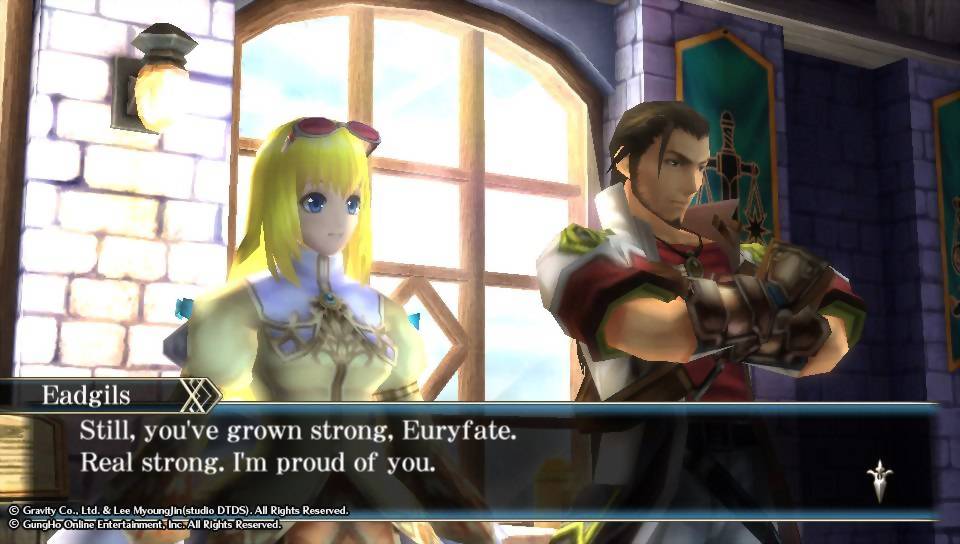
Although once in quests there was little exposition, there was loads of it in the castle town. The writing was enjoyable, but there were walls and walls of text to button through in order to select a fetch quest.
That said, structurally, it was actually quite similar to Phantasy Star Online. After selecting a character class and customizing my avatar, I undertook a variety of odd jobs from a quest counter. They were mindless kill x number of this foe, or collect x number of this drop, with some narrative bits thrown in every now and then. Based on the South Korean MMORPG Ragnarok Online, which in turn was based on the manwha by Lee yung-jin, Ragnarok Odyssey was set in a fantasy world inspired by Norse mythology. Accordingly, every dozen or so quests would include a boss fight against a massive creature of Norse lore, or I’d have to protect our little castle town from attacking giants.
So the mission design wasn’t engaging; I just hacked and slashed my way from room to room until I had met the objective. Back at town, I’d sell some loot, see if there were any improvements I could make to my gear, and repeat. It was quite boring, which honestly, PSO could be too. But comparing the two, it felt like there was more to do in PSO, that there was always something else I was working on besides the main quest line. And really, the only thing this game was lacking is a character level. Simple as it sounds, something like a character level can go a long way when you’re driven to see “the numbers go up;” that is, the damage I dealt.
Further exploring the various crafting systems would probably yield the power I needed.
Despite that, I trucked along with the game for about twenty hours before burning out. I wasn’t really enjoying myself, but seeing as I was already about two-thirds of the way through, momentum took over. Ever the optimist, I also held on thinking things might change, that something might click for me and I’d get it. Still thinking optimistically, I’d like to believe that moment may have eventually come. Ultimately though, I ran into a difficult stretch of quests that I just couldn’t seem to overcome.
Like its influences, this was a game designed with cooperative multiplayer in mind, but whose campaign was also playable entirely alone. I didn’t have too much difficulty in those first twenty hours, thanks to a trio of chances per quest, a couple of AI partners, and a general lack of challenge. I’m sure there’s a way for me to best the bosses that eventually me back, but I just couldn’t figure out what that was. I tried different classes (which admittedly, I wasn’t experienced with), different load outs (which admittedly, probably weren’t well synergized), and… well actually, the answer was probably to grind out material drops and explore the crafting system (which admittedly, I hadn’t up to that point). Up against that wall though, disappointed with what the game and just straight up not enjoying myself, it was easier to just throw in the towel, momentum be damned.
And so, a playthrough that started with so much promise petered out before the credits rolled.
When I’ve sat down to write these year-end lists in the past, I’ve usually done so with a sense of urgency that belies my intentions for them. Inspired by the industry-wide personal best of lists Giant Bomb publishes to celebrate the year that was, I envisioned mine having the same panache. In reality, my procrastination leaves me with little time to revisit my previous sentiments, and the best I can muster is maybe a cursory thought and a link to any applicable reviews (SEO!). The last couple of years, I’ve kept a thorough log of what I played, simultaneously maintaining a top ten list all the while. As such, compiling my favorite games come December isn’t hard; I just don’t leave myself enough time. But this year I’ve got a secret weapon – I’m starting early.
As always, it’s worth clarifying that these are my favorite games that I played this year, regardless of their release. If it wasn’t apparent from my intermittent posting, I don’t have a career in games media and like anyone reading this, I have limited resources available to me, chief amongst them time. As such, the games I do sit down to play are already pretty curated. Now, that doesn’t mean the games themselves are universally regarded, or that I even come to like them, but I’m usually pulling from a list of only about fifty titles. And I try not to include repeat entries, because otherwise Pokémon Sword and Pokémon Go would ALWAYS be present. With those caveats out of the way, let’s get to it!
If someone told you that 2021 was the year they got into Housemarque, you’d assume it was because they fell head over heels for the Finnish video game developer’s newest product, the brutal, beautiful Returnal. That game is a technical showpiece for the PlayStation 5; arguably one of the hard-to-get system’s must play games from its first year on the market. And yet, I have no firsthand experience with it but this was STILL the year I got into Housemarque. So, how’d THAT happen?
When Peggle: Dual Shot failed to fill the role of my next “bedtime” game – a logic-orientated puzzle game, preferably – I went in an entirely different direction. I’d been longing to play some of the classics from the Nintendo DS library that I’d missed, and compiled a shortlist that contained the debut entries in the Phoenix Wright, Etrian Odyssey, and Trauma Center series. The unique qualities and positive reputation of each had drawn me to them for years – and I still plan on playing the “runners up” at… some point – but I ultimately went with the latter of the trio, if anything for its comparable brevity.
Had things gone according to plan, a review for No More Heroes 2: Desperate Struggle would’ve been one of the first articles on this website. I actually still have an in-progress review from over ten years ago, where I started jotting down my thoughts, but alas, nothing ever came of it. Which considering how far I think my writing has come since being *checks notes* twenty years old, it’s probably for the best.
If anything has stuck with me from my high school driver’s ed class, it was a tip from one of the two teachers. While out on a drive, the football coach teacher (as opposed to the softball coach teacher) stated that people tend to focus so closely on the rear of the car in front of them, that they lose consciousness regarding their surroundings. Well, my stupid ass tends to do that with enemy bullets in shoot ‘em ups. I pay such close attention to them – in order to avoid them – that I inevitably and unintentionally lose track of where I am in relation, and wind up right in their path!
When I started playing Peggle: Dual Shot, I envisioned that it could be my next “bedtime” game. That is, something in the vein of Picross or Pic Pic, a game where I could complete puzzles through an almost Zenlike unthinking process, and perhaps listen to a podcast or otherwise just drift off to sleep. Which is a bit of an oxymoron isn’t it, since those games feature logic puzzles, which uh, require you to, you know, think.
You know, I still remember checking out Castlevania on the NES in the early-to-mid 2000s, marveling at the foundations of the series that spawned one of my favorite games at the time, Castlevania: Aria of Sorrow. This had to have been late in my middle school years, perhaps even my first year of high school. I had already been turned onto video games for a year or so, and not too long before I had scored an incredible haul from a garage sale that furthered my interests in retro gaming. It was a NES with, like, all the heavy hitters. I’m talking multiple Super Mario Bros. and Zelda games, Metroid, Contra, the Zapper, and of course, Castlevania. What stuck with me most about checking out Castlevania was its difficulty. I could only get so far – maybe the second boss – before burning out and throwing in the towel.
Fast forward to Halloween afternoon, 2021 and I STILL hadn’t played a thematically appropriate game for the month of October. As one does with scary stories, horror movies, and the like, there’s just something fitting about consuming them in October. At least here in North America, fall is starting to FEEL like fall. It’s getting darker earlier and colder, which makes it harder to enjoy physical activities outdoors, and on top of that, everything’s dying. Why not revel or find solace in a piece of entertainment that mirrors the increasingly dire situation that surrounds oneself? Well after days of seeing Philip Summers – aka “The Hand-Drawn Game Guides guy” – post about his Castlevania exploits on Twitter, I decided I’d do the same!
I concluded my review of Suikoden II stating that “It’s tale of war, viewed from macro and micro perspectives, was better executed than its predecessor, and one that I’ll inevitably judge its successors upon.” Well, the rubber meets the road now that I’ve completed Suikoden III.
![Tom Clancy’s Rainbow Six: Vegas [Xbox 360] – Review](https://mybrainongames.files.wordpress.com/2022/02/tom-clancys-rainbow-six-vegas-xbox-360-north-american-box-art.jpg?w=672&h=372&crop=1)

![Ragnarok Odyssey Ace [PlayStation 3] – Review](https://mybrainongames.files.wordpress.com/2022/01/ragnarok-odyssey-ace-playstation-3-north-american-box-art.jpg?w=672&h=372&crop=1)




![Nex Machina [PlayStation 4] – Review](https://mybrainongames.files.wordpress.com/2021/12/nex_machina_logo_detailed_use_this.png?w=672&h=372&crop=1)

![Trauma Center: Under the Knife [Nintendo DS] – Review](https://mybrainongames.files.wordpress.com/2021/12/trauma-center-under-the-knife-nintendo-ds-north-american-box-art.jpg?w=672&h=372&crop=1)

![No More Heroes III [Switch] – Review](https://mybrainongames.files.wordpress.com/2021/12/no-more-heroes-iii-nintendo-switch-north-american-box-art.jpg?w=672&h=372&crop=1)

![Raiden IV [Xbox 360] – Review](https://mybrainongames.files.wordpress.com/2021/12/raiden-iv-xbox-360-north-american-box-art.jpg?w=672&h=372&crop=1)

![Peggle: Dual Shot [Nintendo DS] – Review](https://mybrainongames.files.wordpress.com/2021/11/peggle-dual-shot-nintendo-ds-north-american-box-art.jpg?w=672&h=372&crop=1)

![Castlevania [NES] – Review](https://mybrainongames.files.wordpress.com/2014/12/castlevania.jpg?w=672&h=372&crop=1)

![Suikoden III [PlayStation 2] – Review](https://mybrainongames.files.wordpress.com/2021/11/suikoden-iii-playstation-2-north-american-box-art.jpg?w=672&h=372&crop=1)

 My Brain on Games