When you have a video game collection like mine, it can be hard to play all of the games. This is especially true when additions are made on an almost weekly basis. Still, I appreciate nearly every game I’ve accumulated for this reason or that. In the hopes of improving my writing through continuous effort and promoting ongoing learning of these games, I’m going to compose brief, descriptive articles.
According to GameRankings, this is the third best reviewed video game of all time, or at least, of a modern age. Just above it is The Legend of Zelda: Ocarina of Time and Super Mario Galaxy. I have played this game before… for a few minutes. I just purchased it this year so you can’t really blame me for not playing it too much yet. Then again, I somehow found time to play Heathcliff: The Fast and the Furriest, so maybe you can blame me… From what I’ve heard about this game, it’s Super Mario Galaxy with Yoshi and tougher stages, akin to Super Mario Bros. 2 (The Lost Levels, you know the real sequel). I’m looking forward to playing it, although I should really finish its predecessor first…
Super Mario Galaxy 2 was developed by Nintendo EAD (Entertainment Analysis & Development). It was published by Nintendo in North America on May 23, 2010.
What can I say about Super Mario Bros.? I mean, it’s Super Mario Bros.Everyone knows about the 1985 classic. Everyone can recall Mario’s initial journey through the Mushroom Kingdom on his quest to rescue Princess Toadstool from the diabolical Bowser. Everyone has stomped on the heads of numerous Goombas, kicked several Koopa shells, and found the game shortening Warp Zones. Everyone has beaten it, ecstatic to see the princess instead of yet another Toad. Well, that is everyone but me.
The music just started playing in your head, I know it did.
After briefly playing Vs. Super Mario Bros. at PJ Gamers, one of my local arcades, I realized I had never beaten the Mario game that started it all. Never mind Donkey Kong, Donkey Kong Jr., or Mario Bros.Super Mario Bros. really kicked off the career of Nintendo’s mascot. Thus, I’ve spent the last week or so playing the game in hours-long sessions attempting to beat it. Finally, after discovering secrets and honing my platforming skills, I’ve gotten good enough to reach the end.
Among other elements, I feel two of the most important are the game’s precise controls and simplicity. They tied together in an interesting way after spending hours learning stage layouts and adapting to the controls. I’d often get reckless and misjudge a jump or run into enemies enough times to deplete my stock of lives OVER AND OVER AGAIN. It could get frustrating, but it was psychological – I was getting too comfortable with my abilities. In many ways, overcoming my careless tendency to hold down the run button was the key to my success.
My experience with the game was enhanced by playing it with a friend, switching off when we’d lost all of our lives. Like most things, playing this game was improved with a partner. The kicker was discovering the hidden 1ups that were necessary to extending our sessions and devising strategies for dealing with tough sections. Accessing the Warp Zones was the most fruitful of our discoveries. I wouldn’t have been able to complete the game without accessing the secrets we did and I wanted to be able to say I completed Super Mario Bros. so there, I said it.
A launch title for the GameCube, this was Luigi’s first game where he received top billing.
After winning a mansion in a contest he didn’t enter, Luigi invites his brother to check out his new digs. After getting lost on his way, Luigi eventually arrives to discover the mansion is packed with ghosts and they’ve captured Mario. The ensuing evening highlights how Luigi’s love for his brother overcomes his lack of confidence. All told though, Luigi’s night is full of mild laughs and humorous encounters rather than deep frights.
There was a bountiful amount of ghosts, one might say the mansion was bountighoul.
To combat the ghosts, Luigi utilizes the Poltergust 3000 – a special vacuum designed by Luigi’s most recent acquaintance, Professor Elvin Gadd. This vacuum sucks in the undead inhabitants and when Luigi returns to the safety of Gadd’s shack outside the mansion, the professor seals the ghosts in portraits. Capturing ghosts was initially a frustrating endeavor but with practice it became easier, but it never felt “just right.” Navigating the mansion was occasionally a laborious affair as well.
The mansion is quite large and it’s full of distinct rooms that are inhabited by similarly distinct ghosts. The mansion was broke up into areas which were capped off with a boss fight against a more menacing foe. Luigi’s Mansion was fairly straightforward, but there were a few times where I wasn’t sure what I needed to do to progress. Also, backtracking was a massive part of the game. Towards the middle of the game, when the number of unexplored rooms was dwindling, I’d usually have to traverse multiple floors in a convoluted fashion to move on.
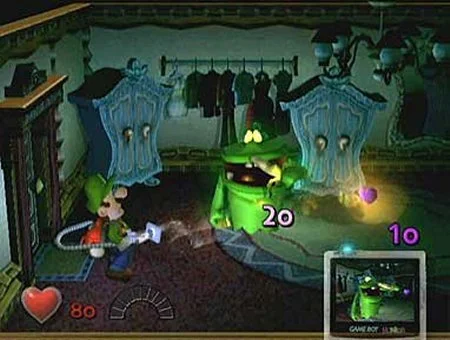
Luigi’s not so sure about that proposition.
The problems I had with Luigi’s Mansion were minor, but were annoying nonetheless. Its gameplay also wasn’t so fantastic as to redeem these annoyances. I felt like my time with Luigi’s Mansion was worthwhile though. It was a very positive, humorous adventure that has me interested in its upcoming sequel.
As is tradition, Skyward Sword features gold on it's box.
The Legend of Zelda is probably my favorite video game series. Nearly every game in the series has a blend of exploration, combat, and puzzles that I find fulfilling. I’ve played nearly every game bearing the name so it shouldn’t come as a surprise that when the newest, Skyward Sword, was released this Sunday, I was at my local GameStop as soon as they opened. I’ve played it for nearly eight hours and wanted to write about what I’ve done so far.
This time around Link is a knight in training at an academy. Rather than a princess, Zelda is a fellow student who admires Link. They live in Skyloft, which happens to rest on a floating island, in the sky. Skyloft is home to many people and there is a bazaar with a handful of shops. There are other floating islands as well and traveling to them on Link’s bird reminds me of sailing in The Wind Waker.
For the first hour and a half I learned about the world around Link and took part in the Wing Ceremony, a contest proving one’s ability as a knight. Soon after this, Link learns that he and Zelda are destined for great things. While celebrating Link’s victory, Zelda was wrapped up in a tornado and fell to the surface. I heard many rumors of the surface as no one seemed to know what was down there. With some aid from an ancient goddess that everyone worships, Link headed to the surface.
Judging by this enemy's mouth, a horizontal slice should take him out.
I’ve completed one temple so far and I’m at the entrance to the second. To get to the first temple I had to navigate Link through some woods which were full of enemies, and a few helpful creatures called Kikwis. There’s one aspect of the art style that really shines in colorful locations like the woods and it’s the way scenery looks from a distance. The game looks cartoony, although it’s not cel-shaded. I’ve heard others describe it as painterly and I agree. When looking at something that’s far away, objects begin to blend together and look like a blotchy watercolor painting; it’s really cool to see.
The first puzzle in the first temple stumped me for a good while. It revolved around using Link’s sword in a specific way that’s only possible with motion controls, which play a large part in the game. Skyward Sword utilizes Wii MotionPlus which makes the motion controls more accurate than would be with a normal Wiimote. Nearly every enemy I’ve run into has required me to attack them in a specific way. The combat is a lot tougher than it’s ever been before, but it’s also more fun because each enemy is a puzzle and requires me to act as though I’m swinging a sword.
What I’ve had the most fun doing so far is completing side quests and exploring. As soon as the opportunity arose, I began flying to other islands and meeting new people. I’ve met many other people besides those on Skyloft and opened up a minigame and some sidequests so far. After completing the first temple, I was able to complete some sidequests back on Skyloft and received some rewards. I’ve been finding treasures like crazy and I’ve bought a lot of upgrades, aiding me greatly.
There are some... colorful characters in the game.
One thing that bugs me about Skyward Sword so far is the controls for falling. I’ve had to fall for long distances many times now and I can’t quite get the hang of the controls. Other than that minor complaint I’m enjoying Skyward Sword. I really like the less realistic art style, I’m having fun fighting enemies and solving puzzles with the motion controls, I’m digging the exploration and rewards, and I’m just glad to play another Zelda game.
One of the best examples of GameCube to Game Boy Advance connectivity I'm sure.
Relationships are hard work. Cooperation is a requirement. If two parties can’t work together, there is no relationship, no way to reach a desired destination. Competition has a place though and no matter the type of relationship, competition will always rear its head. While these concepts can be seen as opposites, managing them is necessary to make any relationship last. Similar to Reese’s with peanut butter and chocolate, The Legend of Zelda: Four Swords Adventure blended these two concepts together and it’s what I’ll remember most about the game.
Four Swords Adventure looks like A Link to the Past but it features effects only possible on the GameCube.
When my girlfriend and I began playing Four Swords Adventure I didn’t anticipate it would take so long to complete. Even with limited time, we saw it through and completed the game’s nine levels with plenty of healthy competition. Rather than the typical open, but linear format of most Zelda titles, Four Swords Adventure is broken into levels which are comprised of stages. Instead of accruing necessary items and then tackling a dungeon, each stage is a self-contained challenge combining puzzles and action.
Four Swords Adventure’s puzzles derived mostly from utilizing the four Links in a specific way. The puzzles weren’t very challenging, but I remember one in the final level which stumped us good. A lot of the mental work simply required us to position the four Links in a specific stance and then stand on a button or hit switches, not very tough stuff. Boss battles were interesting. The bosses represented a “greatest hits” of sorts, but some were slightly remixed to take advantage of the four Links and the use of the Game Boy Advance.
The game’s use of the GBA was clever, but ultimately its Achilles heel. Instead of controlling our Links with a GameCube controller, we had to plug in a GBA and use it. Whenever we’d enter into a building or a cave or what have you, that person’s Link would then be transferred to the GBA. This allowed each person to explore the screen and its contents individually while not hindering others. To play the game like this, it requires that each person have a GBA and link cable, which makes the game hard to recommend to those who don’t have at least some of these items already. Playing alone just requires a GameCube controller, no extra accessories. Without others though, the game doesn’t really merit a playthrough.
Princess Zelda and the six shrine maidens get captured by Shadow Link who leads Link to the Four Sword. When Link removes the Four Sword from its shrine he is split into four and the evil Vaati is released. As Link rescues the maidens and retrieves four special jewels, Ganon makes his presence known. The game took my girlfriend and me through many villages and we got a lot of back-story through NPCs and Kaepora Gaebora. As mentioned earlier, it was a lengthy game and well suited for bite sized sessions.
My girlfriend and I accomplished our objectives through a variety of ways, like sneaking around.
Link’s quest was familiar; rescue a bunch of something and overcome evil, but there wasn’t a detailed narrative to propel my girlfriend and I forward. Thankfully this driving force was replaced by the unique duality of the gameplay. It’s hard to recommend because of the requirements, but The Legend of Zelda: Four Swords Adventure is a noteworthy example of games that blend cooperative and competitive gameplay, a difficult relationship to manage.
The Legend of Zelda: Four Swords Adventure was released on GameCube in the USA on June 7, 2004. It was developed by Nintendo EAD and published by Nintendo.
4/5
Links (ha ha):
The Legend of Zelda: Four Swords Adventure
Nintendo
Share this:
Twitter
Facebook
Tumblr
Like this:
LikeLoading...
The internet's source for Mansion of Hidden Souls.
![Random Game #22 – Super Mario Galaxy 2 [Wii]](https://mybrainongames.files.wordpress.com/2014/12/super-mario-galaxy-2.jpg?w=672&h=372&crop=1)

![Super Mario Bros. [NES] – Review](https://mybrainongames.files.wordpress.com/2014/02/super-mario-bros.jpg?w=672&h=372&crop=1)
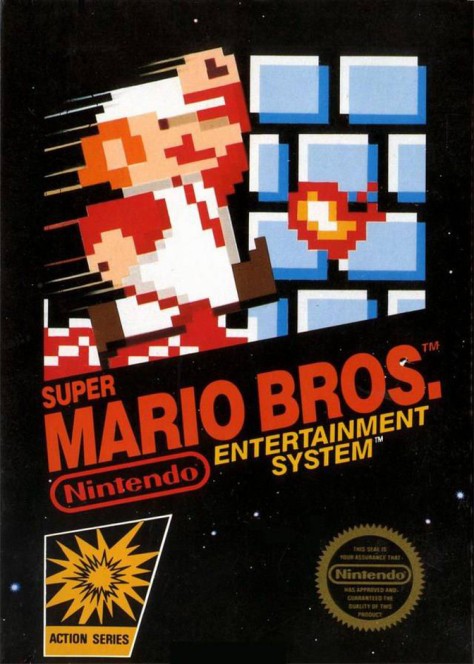 What can I say about Super Mario Bros.? I mean, it’s Super Mario Bros. Everyone knows about the 1985 classic. Everyone can recall Mario’s initial journey through the Mushroom Kingdom on his quest to rescue Princess Toadstool from the diabolical Bowser. Everyone has stomped on the heads of numerous Goombas, kicked several Koopa shells, and found the game shortening Warp Zones. Everyone has beaten it, ecstatic to see the princess instead of yet another Toad. Well, that is everyone but me.




 My Brain on Games