Awww, Mawww!

Awww, Mawww!

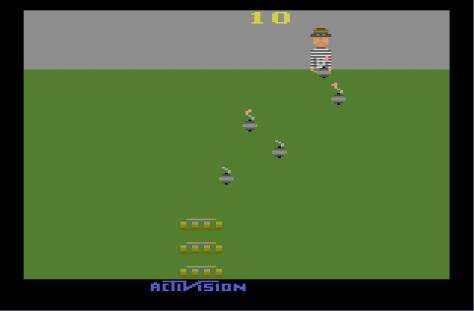
If you imagine that Dirty Jobs’ Mike Rowe was tasked with filling the cowboy boots of a rancher, it might play out akin to Activision’s Stampede. Then again, this game would be a one-dimensional look at the multi-faceted career that being a rancher entails. Plus, it looks so old!

Designed by Bob Whitehead and released for the Atari 2600 in 1981 (it was also ported to the Intellivision in 1982), Stampede is right ol’ good time. Lassoing cattle is the objective and beyond that, it’s simply about getting the highest score possible. Letting three cattle pass means the end of the game and time to start anew. I didn’t like Stampede initially but with the realization that bumping into to the cattle prevented them from going off-screen and made them giddy up allowed me more of a chance to perform and this newfound mechanic turned me around on Stampede.

The cattle came in a few colors, each stampeding at a different speed.

The cattle came in a few colors, each stampeding at a different speed.

With scores of north of 1,500 in games 1 and 3, players will unlock a commercial, patch, and a gameplay mode in Activision Anthology. The commercial really plays off of the game’s theme whereas the multi-screen gameplay mode screams MTV circa 1987.

Alan Miller, turning it around with this one.

Alan Miller, turning it around with this one.

When I realized that Tennis was designed by Alan Miller, I had low expectations for it. Ice Hockey was also designed by him and that is my least favorite Activision game from this era, thus far. I was pleasantly surprised though as Tennis has some of the briskest gameplay I’ve seen on the Atari 2600.

Playing matches against a human opponent was great. There’s not much variety in the way of different shots (only one button on the Atari 2600) but the sheer speed more than made up for this. With a little practice, my friend and I were having contentious volleys that were won on errors more often than not. Playing against the computer is another story though. The computer is adept and winning a volley takes a lot of effort. More than I was willing to put in.

I’d like to think the more my friend and I trash talk each other, the more comfortable we feel with a game, and the more we like it. If that’s a positive sign then Tennis is one of the best multiplayer games we’ve played on the Atari 2600.

Gameplay was fast and fun with a human opponent.

Gameplay was fast and fun with a human opponent.

Winning a match against the computer nets both the commercial and the patch for Tennis in Activision Anthology. I could not triumph and so inserting the hyperlink to the commercial will also be the first time I view it.

Almost had all of the sticker removed.

Almost had all of the sticker removed.

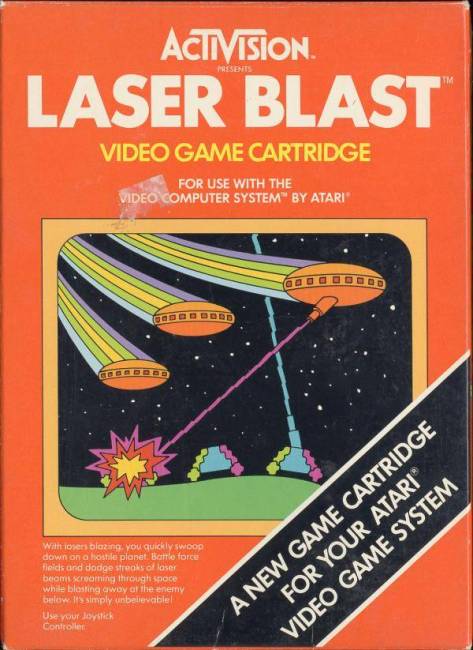
Up for discussion today is yet another David Crane game, Laser Blast. It was published by Activision for the Atari 2600 in 1981 and in a sense, flips the player’s role in the fixed-screen shoot ‘em up that was so popular in this era.

Rather than controlling an Earth defense force of some type, protecting our home planet, Laser Blast has players controlling the invading aliens. Flying UFOs and destroying the enemy artillery is the task at hand, but after a few rounds the game grows extremely stale. Screens are comprised of three moving enemies and with them destroyed, the player flies to the next screen, with the same makeup. Rinse and repeat forever. There is no end and it makes a good score attack game, but the gameplay is just so tepid. The best thing about Laser Blast is the ability to control the UFO after it has been shot down, enabling players to kamikaze the ground targets.

After being shot down, players can kamikaze the ground forces.

After being shot down, players can kamikaze the ground forces.

There are two patches and a commercial to unlock in Activision Anthology. The commercial comes after losing all lives while the patches require 10,000 and 100,000 points. 10,000 isn’t too bad but 100,000 requires a half-hour or so of formulaic shooting. It’s easy to get, but there are better things to spend time on. Unfortunately I realized that after getting the patch.

No stickers?

No stickers?

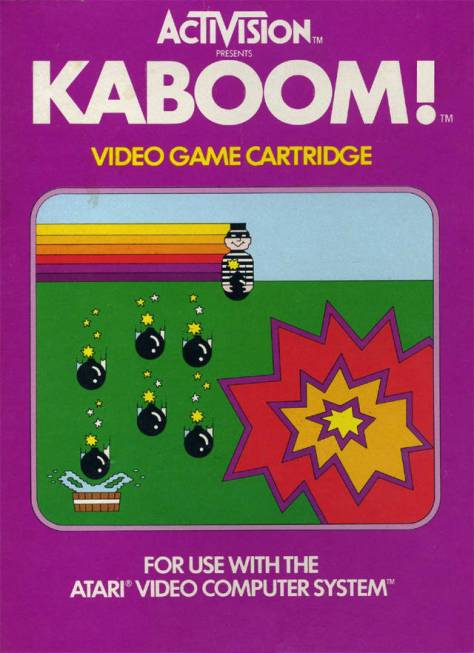
Kaboom! is the first of Activision’s games that was not released solely on the Atari 2600. However, it is the version I shall discuss (by way of Activision Anthology on the PlayStation 2 that is). Released in 1981 and designed by Larry Kaplan, versions were also released for the Atari 5200 and their line of 8-bit computers. It would’ve been nice to see these additional versions included in Activision Anthology, but the package was quite the focused effort.

I want to say this is the simplest game of the bunch I’ll write about, but they’re all pretty simple. If I took this game to my parents, they’d instantly get it, and be hooked for a short while too. The “Mad Bomber” resides at the top of the screen and will drop bombs as long the player has buckets to catch them. Miss three bombs and that’s it. This is a score attack game through and through.

On the Atari 2600, Kaboom! utilized the paddle controller which featured a knob not unlike a radio dial. Turning it moved the buckets. This aspect of the game doesn’t hold up in Activision Anthology. Using the analog sticks or the d-pad just doesn’t cut it 100%. It’s workable, but I think it’d be tough to really excel. I have played the iOS version and using the touch screen is a good alternative, but that makes it too easy. I know, I know – I’m hot, I’m cold, I don’t know what I want! Either way you play it, play it; I really like this game.

Analog sticks and d-pads aren't ideal for this game.

Analog sticks and d-pads aren’t ideal for this game.

With the PS2 version being my main version, I did put in the time to unlock Kaboom!’s patch and commercial. Unlocking the patch was a walk in the park compared to what was originally required; unlocking it required at least two hundred points compared to the original sum of at least three thousand!

Stickers...

Stickers…

I found plenty to like in Activision’s catalog of Atari 2600 games, but Ice Hockey didn’t really rank for me. Designed by Alan Miller and published by Activision in 1981, this two-on-two representation of the sport didn’t have the control or speed I was looking for.

Teams were comprised of two players, of which only the one closest to the puck would be controlled by the actual player. Also, the goaltender couldn’t exceed the middle of the rink; the other skater could be on both ends, but it got a little sketchy when both teammates were on the same side. What irked me was their movement.

They moved as though they were walking on the ice rather than skating on it, fumbling around trying not to fall. Basic control of the puck I found to be “off” as well, or perhaps, required a greater knowledge of the mechanics of the game. A player could hold the action button and flail about without repercussion; in fact, I found this to be a pretty solid defense. It was hard to be offensive like this, ironically enough. What worked was a more subdued presence on the rink and some strategy to have the opponent “misplace” their offensive player in a spot away from the fray. This was done by hovering around the center and forcing the opponent to alternate between their two skaters.

Spider-Man (Men?) vs. Brazil!

Spider-Man (Men?) vs. Brazil!

Regardless of understanding a valid strategy or two, Ice Hockey wasn’t my cup of tea. That doesn’t mean I didn’t unlock the related patch and commercial in Activision Anthology though. All I had to do was win a game against the computer and score four points in less than two minutes against the computer. After all, how else would I have figured out a valid strategy or two?

Damn stickers!

Damn stickers!

Freeway will undoubtedly draw comparisons to Frogger, but it has a leg or two of its own to stand on. Designed by David Crane and published by Activision for the Atari 2600 in 1981, Freeway centers on the timeless question of why the chicken crossed the road. While it provides no answers, it does provide a good time.

Meant for two players but playable solo dolo, the objective is to get as many chickens as possible to the other side of the freeway in a limited time frame – two minutes and sixteen seconds to be precise. Great playability and a fun premise are two positives but this game truly shines with a human opponent. With ten stages of varied difficulty, Freeway is something to crow about.

Very simple, very addicting.

Very simple, very addicting.

Unlocking Freeway’s original commercial and patch are two bonuses players can find in Activision Anthology. The commercial requires at least 30 points in game 1, which is attainable after a round or two, while the patch amps the challenge up requiring at least 10 points in game 3 or 7 – much more difficult, but not impossible.

Space, the most common frontier for video games in the late 70s and early 80s.

An armada of bomb-dropping aliens will wreak havoc on Earth’s defenses unless players take them out effectively. The bunkers can withstand a formidable amount of damage but they won’t last forever. The fleets are never-ending and they’ll require more skill as time flies by. This is Space Armada, a blatant clone of Space Invaders. It was released for the Mattel Intellivision in 1981 and developed by John Brooks and Chris Hawley, programmers at APh Technological Consulting.

Space Invaders, er, Armada as seen in XBLA’s Game Room.

John: Wow, this is unashamedly a clone of Space Invaders; a hard one to boot. I like that the game is very colorful and it plays well, but it’ll take a lot of practice to make progress.

Jeff:  This was a clone of Space Invaders; very simple and somewhat responsive. I just didn’t like how the first stage appears to be impossible to pass. I know it is possible, but just not worth the effort. The arcade industry didn’t have much reason to worry about home consoles at this point in time and I can see why.

Groovy!

Snafu is a game for the Mattel Intellivision hailing straight out of Mattel, courtesy of Mike Minkoff. Released in 1981, it’s a game where players control an ever growing snake and attempt to be the last of four to survive. The game gets trickier the longer a match lasts and it’s ideal for two players.

The common snake game is a blast on any platform, even Nokia cellphones!

John: One of the best games we played. It was a fun variant of the familiar snake game and it actually had a soundtrack, not just beeps and boops. This brought back memories of me draining the batteries on my dad’s Nokia cell phone; really fun game.

Jeff:  This was one of the best games that I’ve played on the Intellivision, although that isn’t saying much. After all, this was just competitive snakes on a thirty year old system.

One of the more decent games on the system.

Earth is being pelted by falling rocks, bombs, guided missiles, and UFOs and it’s up to players to protect it as best they can in Astrosmash. Released for the Mattel Intellivision in 1981, Astrosmash plays like a cross between Space Invaders and Asteroids; fittingly the game is all about getting a high score. John Sohl from Mattel Electronics developed Astrosmash. The only other game to his name on the platform was B-17 Bomber.

Astrosmash as seen in XBLA’s Game Room.

John: An interesting arcade style game that was relatively fast-moving game, although it seemed quite easy up to the point where we finished. Because we kept earning lives rather than losing them, we decided to award the game to whoever got the most points using one life. The falling rocks breaking apart into smaller pieces and the hyperspace features were reminiscent of Asteroids and the game in general had a lot in common with Space Invaders. It turned out to be one of the better games we played on the INTV and it was one of the best looking.

Jeff: It reminded me more of Missile Command at first because of the laser gun’s position but I’ll concede that it had more of a Space Invaders vibe. I think the INTV’s disc pad is the biggest downfall to this game. The game was functional and decent overall, but I HATE the INTV’s controller!

There are 66 variations of the standard game, each featuring a unique combination of settings.

When I devised the competition between my friend and I where we play every video game we collectively own, I knew witnessing the growth of the medium firsthand would be a plus. Now that we’ve played through my collection of Atari 2600 games, I’ll flood the internet with my thoughts on selected titles. I’ll begin with Asteroids.

Asteroids is a classic. Originally released as an arcade game in 1979, it’s heralded as one of the most popular and influential video games of all time. It was released for the 2600 in 1981 and while it differs from the arcade version, it’s a fun version of the game nonetheless.

Asteroids for the Atari 2600 looks much simpler in comparison to the arcade version (pictured below) but it seems to replicate the gameplay very well.

I’ve never been a huge fan of the game, although this session something “clicked” and I got it. The thing that I’d been missing in all of my previous experiences with Asteroids was competition. Without another person to compete against, the game is unfulfilling, unless you’re a person who is adamant about besting a personal score.

Learning to effectively steer and thrust the spaceship is the first key to success. The spaceship’s tendency is to remain still. If I’m not pushing the thrust button, it’s not moving. So when I press it, the spaceship only moves for as long as I press it before coasting to a standstill again. Piloting this spaceship wouldn’t be of much concern were it not for the unbridled asteroids whizzing through space.

The single screen that Asteroids takes place in is chock full of the game’s namesake as well as the occasional UFO. Lucky for me, I was piloting a spaceship that was prepared for the unknown, kind of. As the spaceship is traveling in a potentially dangerous screen of space, it’s naturally equipped with weaponry. However, like modern-day NASA, I imagine the makers of this spaceship were also suffering from a reduced budget because its weaponry doesn’t outright destroy large asteroids but breaks them into smaller ones. Managing them was the second key to success. If I began haphazardly shooting, I’d rack up points quickly, but piloting around the leftover chunks of asteroids would prove to be overwhelming.

A screenshot from the arcade version of Asteroids.

Playing a lot of simpler games has made me think deeply about video games. At their most basic level, they’re puzzles tasking us to understand their unique set of rules, adapt, and conquer them. Asteroids is so fun because of that formula. Controlling the spaceship and managing the destruction of asteroids are the two major aspects of the game, that’s really it, and with someone to compete against, it’s out of this world.

Follow

Get every new post delivered to your Inbox.

Join 168 other followers