After completing Ys: The Vanished Omens, I decided to pause my Sega Master System playthroughs and turn my attention to a couple of recently acquired Atari 2600 games. Kangaroo was the first on my list. Published by Atari in 1983, it’s a port of the Sun Electronics (Sunsoft) arcade game released the year before, itself a derivative of Nintendo’s Donkey Kong. Playing as a mother kangaroo, I had to scale three distinct stages to rescue her captive joey. Along the way, I dealt with an endless barrel of apple throwing monkeys by boxing them into submission or avoiding them altogether. Continue reading Kangaroo [Atari 2600] – Review and Let’s Play→
My Atari 2600 has been getting some love this week! Now that I’m done with Vanguard, I’ve returned to Phoenix, which I was playing beforehand. In fact, it’s the reason I’m playing these games at all; my recent acquisition prompted me to hook up the console and try it out. Like Vanguard, it’s a space-themed shoot ‘em up (you want me to stop there, right?) although being a fixed shooter, it has more in common with its contemporaries, such as Space Invaders and Galaxian. I enjoyed this game’s fast-pace and responsive controls, the most important factors causing my return to it.
The Atari 2600 version.
As was the case with Vanguard, Phoenix was originally released in the arcades courtesy of Centuri. At least, in the United States; elsewhere it was published by Taito. It was introduced in 1980 and as best I can tell, was the sole output of developer Amstar Electronics. After obtaining the rights to produce a home console version, Atari outsourced development to General Computer Corporation and the final product was released in 1982. A little research reveals Michael Feinstein to be one of the port’s programmers and likely, the project lead.
And the original Arcade version.
The objective of Phoenix is to destroy the adversarial mothership. To reach it, players must defeat four waves of birdlike enemies. The first two waves are host to rudimentary foes that could easily be mistaken for Space Invaders fodder. The next two waves feature enemies that move faster along less predictable paths. These foes are larger and have wings that can be destroyed, but they regrow if the core of the creature isn’t shot. Finally, the penultimate stage hosts a large alien vessel that has to be whittled away until the player can eventually strike its alien pilot. With the leader destroyed, the game recycles these stages in perpetuity.
At this point, the game becomes about setting a high score. I wasn’t drawn into playing the game for so long because of this element per se, but having a competitive nature didn’t hurt! I found this to be a challenging game and I believe I’ve only been able to make it past two full sets of stages thus far. Each time I die, I feel like it was totally on me. Because the player’s spaceship moves quickly and is so responsive to input, I’m always left feeling as though I could’ve evaded the shot that killed me. This draws me in and makes me want to continue improving in an effort to get just a little farther. So even though it’s challenging, it feels like the scales are evenly tipped between the player and computer.
The mothership of the enemies.
Phoenix is a stellar shoot ‘em up and as described is a challenging, fast-paced, responsive game that I wanted to continue playing in spite of the constant death. There’s more to it then my brief descriptions highlight, such as reaping more points for destroying closer enemies, but this tactical element didn’t factor into my sessions. That’s the sort of element that I foresee giving the game a longer tail once I move beyond just trying to see new waves and convert over to strictly score chasing. Until that point, I’m content to continue enjoying the game and my Atari 2600 as I have been.
Vanguard is a space-themed shoot ‘em up from the early 1980s. Stop me if you’ve heard this one before. Oh, you have? That’s right; basically every other video game from that period was a space-themed shooter. This isn’t bad in itself, there were many good games that could be reductively described as such, but so many were innovatively lacking. That’s not an issue with Vanguard.
It debuted in the United States during the “golden age of arcade games” in 1981 courtesy of Centuri. In its native Japan it was released by SNK and purportedly developed by TOSE, although they don’t want you to know that. My focus isn’t on that version though (haven’t played it) but instead the Atari 2600 port. It was released in 1982 (or maybe 1983) and was ported by Atari, or rather Dave Payne at General Computer Corporation.
Many games on the Atari 2600 utilized a rainbow color palette and I’d say these games look vibrant.
One thing that set Vanguard apart in arcades was its status as a multidirectional shooter. When it was originally released, it featured a joystick to pilot a spaceship and buttons arranged to fire in one of four directions. In essence, it was a dual-joystick shooter, minus a joystick. With a joystick and a single button, the Atari 2600 wasn’t the ideal platform to port it to, but it was the most popular home console at the time, and Dave Payne ultimately made it work.
The solution was to have the button govern the player’s attack along with directional input from the joystick. To fire to the left, push left and press the button, etc. This works, but it does present an issue: the ship continues to move in the direction the joystick’s being pushed. Initially, I found it difficult to attack enemies that were heading towards me since my attempts hastened our collision. Accordingly, evasion became a focus of mine when dealing with faster enemies. Progression, as best I could tell, was dependent upon destroying enough enemies or reaching a points threshold, so confrontation was inevitable. Ultimately, I had to direct my aggression towards easily targeted enemies while zipping around others.
Progression presented another unique aspect of Vanguard: stage variety. There’s some semblance of a story that involves human space colonists attacking an antagonistic alien species on an asteroid they call home. The caves and crevices that the player flies through are set against distinctive backdrops and feature varying enemies. Before each stage, the player is shown their position within a tunnel which corresponds to the direction of forward momentum in the succeeding stage. This entailed the game featuring a mixture of horizontally and vertically scrolling stages, something very rarely seen in the genre.
Before each stage, the player is alerted to their position within the asteroid.
Despite an awkward control scheme, my time with Vanguard remained fresh thanks to the variety of stages and enemies I had to contend with. I was able to adjust and devise strategies to defeat enemy waves, although I never became totally comfortable within the half-hour or so I spent playing. In this time span, I beat the first set of stages and it’s my belief that they simply repeat in tougher iterations, ad nauseam. It’s a remarkably colorful game and quite detailed considering the platform but is audibly devoid, save for a handful of sound effects. Vanguard is definitely more than just another space-themed shoot ‘em up and is well worth a look for Atari 2600 owners.
When you have a video game collection like mine, it can be hard to play all of the games. This is especially true when additions are made on an almost weekly basis. Still, I appreciate nearly every game I’ve accumulated for this reason or that. In the hopes of improving my writing through continuous effort and promoting ongoing learning of these games, I’m going to compose brief, descriptive articles.
I’ve played little of this game since acquiring the Odyssey2 and expanding my collection. Put simply, it’s a Pac-Man clone. It’s not a 1:1 duplicate, but it’s hard to deny that fact. In fact, this game was the center of a lawsuit that Atari brought upon Philips, the parent company of Magnavox. Atari brought the case, rather than Namco, as they had the exclusive right to home versions of Pac-Man. The Wikipedia pages for the game and a related court case offer an interesting summation of the early days of video game copyrights, as they pertained to North America. As I mentioned, I’ve probably played this game a few times, but I remember it not.
As was the case with the bulk of the platform’s library, K.C. Munchkin! was developed by Ed Averett and published directly by Magnavox. This game released in North America sometime in 1981.
When you have a video game collection like mine, it can be hard to play all of the games. This is especially true when additions are made on an almost weekly basis. Still, I appreciate nearly every game I’ve accumulated for this reason or that. In the hopes of improving my writing through continuous effort and promoting ongoing learning of these games, I’m going to compose brief, descriptive articles.
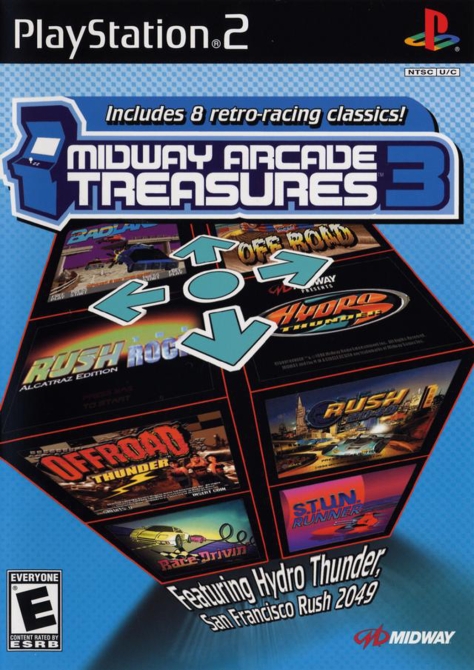
The Midway Arcade Treasures series was a great batch of compilations. The three releases on the PlayStation 2, Xbox, and GameCube compiled around 60 arcade games spanning 20 years. The third game differed from the previous two as it focused on a single genre – racing games. A majority of the games didn’t resonate with me as they were classic top-down racers. I can appreciate them, and enjoy them in multiplayer, but my focus was honed in on two titles – Hydro Thunder and Offroad Thunder. These two 1999 releases were the epitome of what arcade racing games were at that point – flashy, fast, and fun. Completely unlike Race Drivin’…
Midway Arcade Treasures 3 was released in North America on the PlayStation 2 and Xbox on September 26, 2005 and on the GameCube exactly one month later – October 26, 2005. The individual games were primarily developed by Atari Games and Midway Games, although there are some other studios in the mix. The ports were handled by Digital Eclipse and the game was published by Midway.
Released a year apart from each other, it was enough time for Atari to redesign their box art template.
The Atari 2600 was host to plenty of arcade ports. None of them were able to 100% duplicate the original arcade game due to comparatively paltry processing power, but many were successful to varying degrees. Two games that well highlight the stark differences between landing on either end of the quality spectrum are Pac-Man and Galaxian. Ironically both of these titles are based on Namco arcade games.
The story behind Pac-Man’s development is an interesting one. Having previously obtained the rights to develop home versions of Namco’s arcade games, Atari sought to capitalize on the success of Pac-Man. Tod Frye, a programmer within Atari, was tasked with the game’s development, not with the most capable tools though; reportedly, rather than using a newer cartridge, one with more memory, his work was confined to the smaller cartridge to reduce manufacturing costs. This factor, along with the reduced processing power of the Atari 2600 compared to the Pac-Man arcade cabinet, compromised the game’s quality.
Pac-Man, fixing to eat some… fruit?
What Frye produced is totally playable, and resembles Pac-Man undeniably, but its differences are negatives. The maze is unchanging, the ghosts constantly flicker, they’re indistinguishable, the sound effects are grating, the game doesn’t have as good a sense of control over Pac-Man, and so on. It went on to be a great seller at the time (a whopping 7 million copies), but it’s a game that nowadays is best left for those with nostalgia or a deep interest in the medium.
Galaxian on the other hand was released a year after Pac-Man in 1983 on the newer, larger cartridge which provided more space for the programmers to work with. The improvements are night and day. Firstly, Galaxian resembles its arcade brethren to a striking degree (considering it’s a 2600 game). There’s a lot happening on-screen, the graphics are vibrant, and the action is smooth and brisk. Both games are of the score chase variety, but Galaxian is a more enjoyable experience thanks to its more appealing visuals and quality gameplay.
Now details surrounding Pac-Man’s development are well-known and easy to find, but not so with the Atari 2600 version of Galaxian. With some digging, I was able to find out that it was developed not directly by Atari, but rather by General Computer Corporation. GCC was initially a company that modded arcade games; in fact, they’re responsible for Ms. Pac-Man, not Namco! Anyways, Atari filed a lawsuit against GCC but later settled and began outsourcing projects to them.
Upon further digging I was able to determine that Mark Ackerman was the project lead for Galaxian and was assisted by Glen Parker and Tom Calderwood. Mark Ackerman also worked on the 2600 versions of Ms. Pac-Man and Moon Patrol before overseeing the development of a few Atari 7800 titles and leaving game development. Now a professor at the University of Michigan, I emailed Mr. Ackerman and got some feedback on Galaxian’s development.
The contrast between the graphical complexity and palette of colors between the two games is astounding.
Of note were a few programming tricks that resulted in a better game. Utilizing the random number generator from Donald Knuth’s The Art of Computer Programming resulted in smoother gameplay over Pac-Man. A more advanced algorithm was used to reduce the amount of flicker caused by movement – it definitely works! Lastly, Mr. Ackermen devised a way for eight characters to be displayed on screen when, technologically, the system wasn’t capable of displaying more than six. For this feat he was awarded a patent.
Bottom line is this: I wouldn’t be sad if I could only play the Atari 2600 version of Galaxian, not the case with Pac-Man.
Like most Atari 2600 games, this one boasts multiple variations of the core gameplay.
More so than ever before, I’ve been researching the designers of the games I’m writing about. The games in question are the Atari 2600 titles I decided to highlight from my collection. I’m fascinated by the stories behind their development and the fact that they were developed either by a single person or a small team. Today I felt like highlighting Maze Craze: A Game of Cops ‘n Robbers.
Maze Craze is a game like those pencil puzzles from childhood, the ones that were mazes where you had to draw your way to the exit. The concept grows dull with no one else around, but two player races are pretty fun. Mocking the pronounced footsteps and occasional user error is part of the game’s charm. Better yet, there are multiple variations on the game that switch things up and keep the game fresh.
Make one mistake and your opponent has got a good chance at winning.
Richard “Rick” Mauer was the designer behind Maze Craze and according to him, he was influenced by a Fairchild Channel F game, specifically Videocart-10: Maze. [1] [2] The only other video game attributed to Rick is the Atari 2600 version of Space Invaders. This game went on to sell 2 million copies and provoked a quadrupling of sales of the Atari 2600. [3] However, Rick reportedly only made $11,000 for his work on the game and abandoned game development. [4]
It’s a simple game and one that isn’t very fulfilling without someone to play with, but Maze Craze’s use of familiar maze puzzles proves to be an interesting video game.
The invisible maze game, one of the more interesting variations of the game.
Works Cited
[1] Hague, James. “Reminiscing from Richard Mauer.” 5 January 1999. Dadgum Games. 4 August 2012
[2] Videocart-10: Maze. 4 August 2012
[3] AgentKane, Alpha Unit and Noble Team 1. Space! List Collab:Alpha Unit, Noble Team 1, AgentKane. 1 March 2012. 5 August 2012
[4] GameSpy Staff. “#15 Atari Brings Space Invaders Home.” 21-25 July 2003. GameSpy. 4 August 2012
There are 66 variations of the standard game, each featuring a unique combination of settings.
When I devised the competition between my friend and I where we play every video game we collectively own, I knew witnessing the growth of the medium firsthand would be a plus. Now that we’ve played through my collection of Atari 2600 games, I’ll flood the internet with my thoughts on selected titles. I’ll begin with Asteroids.
Asteroids is a classic. Originally released as an arcade game in 1979, it’s heralded as one of the most popular and influential video games of all time. It was released for the 2600 in 1981 and while it differs from the arcade version, it’s a fun version of the game nonetheless.
Asteroids for the Atari 2600 looks much simpler in comparison to the arcade version (pictured below) but it seems to replicate the gameplay very well.
I’ve never been a huge fan of the game, although this session something “clicked” and I got it. The thing that I’d been missing in all of my previous experiences with Asteroids was competition. Without another person to compete against, the game is unfulfilling, unless you’re a person who is adamant about besting a personal score.
Learning to effectively steer and thrust the spaceship is the first key to success. The spaceship’s tendency is to remain still. If I’m not pushing the thrust button, it’s not moving. So when I press it, the spaceship only moves for as long as I press it before coasting to a standstill again. Piloting this spaceship wouldn’t be of much concern were it not for the unbridled asteroids whizzing through space.
The single screen that Asteroids takes place in is chock full of the game’s namesake as well as the occasional UFO. Lucky for me, I was piloting a spaceship that was prepared for the unknown, kind of. As the spaceship is traveling in a potentially dangerous screen of space, it’s naturally equipped with weaponry. However, like modern-day NASA, I imagine the makers of this spaceship were also suffering from a reduced budget because its weaponry doesn’t outright destroy large asteroids but breaks them into smaller ones. Managing them was the second key to success. If I began haphazardly shooting, I’d rack up points quickly, but piloting around the leftover chunks of asteroids would prove to be overwhelming.
A screenshot from the arcade version of Asteroids.
Playing a lot of simpler games has made me think deeply about video games. At their most basic level, they’re puzzles tasking us to understand their unique set of rules, adapt, and conquer them. Asteroids is so fun because of that formula. Controlling the spaceship and managing the destruction of asteroids are the two major aspects of the game, that’s really it, and with someone to compete against, it’s out of this world.
This reboot of a classic arcade game is less than stellar.
In the interest of making money, some companies resort to rebooting their classic franchises and the results are usually less than stellar. This is a common practice for Atari and its stable of classics from the 70s and 80s. Since the era of the Atari 2600 and the golden age of arcades, Atari has struggled and been in the hands of many. In the late 90s when Hasbro owned Atari, Pong, Missile Command, and Centipede were rebooted. They’ve once again fallen back on their classic lineup and last year’s Centipede: Infestation from respected developer WayForward Technologies is one of their newest reboots.
With a strong Saturday morning cartoon vibe, Centipede: Infestation is definitely skewed towards a younger audience. In between stages, stills of animation and goofy voice-acting propel the budding relationship of Max and Maisy. The young gun-for-hire and gardener live in a post-apocalyptic world devastated by giant, radiated bugs and surviving is their day-to-day goal.
Centipede: Infestation cribs from another early 80s classic: Robotron: 2084. In that game, stages were very quick and players were tasked with destroying enemies, rescuing innocents, and surviving. The common element between them is the control scheme and arena-style stages. Robotron: 2084 spawned the dual-joystick shooter that has been oh-so popular in the past handful of years.
Harking back to the original, a giant centipede caps off each stage, telegraphing its movements.
The analog moves Max while the face buttons shoot. Shooting in four directions isn’t very fluid and it caused me to try and shoot in one direction the entire time and “walk” my weapon fire into enemies. To be fair, you can shoot diagonally as well, but it didn’t make me change my strategy.
Stages in Centipede: Infestation take place in small arenas and players help Max survive by killing enemy bugs with his gun, powerful stomp, and power-ups. Capping off stages are fateful battles with a centipede whose movements call to mind the original Centipede. Stages are short and sweet and although the shooting isn’t perfect, the dual-joystick genre is still easy enough to get into and most importantly, fun.
The game does support co-operative play, but both people need a copy.
Reboots of classics usually aren’t successful but there are always exceptions – Pac Man Championship Edition (DX too!) comes to mind and I’ll include Galaga Legions because I like it. Centipede: Infestation isn’t the Centipede game people will remember and, while enjoyable, it’s not for me.
By the way, a dozen or so classic Atari 2600 games are available to play for free on Atari’s website.
Figuring I might have a little bit of free time on a trip to visit my girlfriend’s family, I decided to bring along my PSP and a few games. Of the games I brought, Hot Pixel received the most attention. It was developed in France by zSLide and published by Atari on October 2, 2007.
Massage the tattoo on this lady's back, but quickly!
Hot Pixel is really nothing more than a WarioWare clone with an urban theme. It sticks with the idea of microgames and coasts on that idea for about an hour, the time it took me to beat the game and finish with 67% completion. The core mode is broken up into ten episodes consisting of about ten microgames as well as a boss battle. Whereas the microgames lasted a few seconds at most, the boss battles were slightly longer, like a remixed round of Breakout. This isn’t the only remixed Atari classic in the game but there aren’t that many; I wish there was there was more of an emphasis on utilizing Atari’s catalog of old games.
One feature that I thought was inventive was the addition of playlists. Hot Pixel comes preloaded with many playlists, usually with clever parameters; they can be customized too. I can’t follow up the previous paragraph with one composed of two sentences and I still want to talk about unlockables, so I will! They were lame. There doesn’t seem to be a lot and the ones I unlocked weren’t compelling enough to keep me playing to see what else there was. I was rewarded with pixels for completing games, but they weren’t used for anything. I would’ve liked to see an abundance of unlockables and a shop where pixels were spent, but that wasn’t the case.
This game of Breakout takes place on a skyscraper.
Like Mr. Driller: Drill Spirits, Hot Pixel was satisfying for a short period of time. I didn’t dig every microgame I played, many were too similar, and I wish the game played up Atari’s past more but the game was enjoyable nonetheless. There isn’t enough of a reason for it to be a primary focus, but it’s great for a trip.
2/5
Share this:
Twitter
Facebook
Tumblr
Like this:
LikeLoading...
The internet's source for Mansion of Hidden Souls.
![Kangaroo [Atari 2600] – Review and Let’s Play](https://mybrainongames.files.wordpress.com/2016/09/kangaroo1.jpg?w=672&h=372&crop=1)

![Phoenix [Atari 2600] – Review](https://mybrainongames.files.wordpress.com/2016/01/phoenix.jpg?w=672&h=372&crop=1)


![Vanguard [Atari 2600] – Review](https://mybrainongames.files.wordpress.com/2016/01/vanguard.jpg?w=672&h=372&crop=1)


![Random Game #35 – K.C. Munchkin! [Odyssey 2]](https://mybrainongames.files.wordpress.com/2015/01/k-c-munchkin.jpg?w=672&h=372&crop=1)

![Random Game #8 – Midway Arcade Treasures 3 [PlayStation 2]](https://mybrainongames.files.wordpress.com/2014/12/midway-arcade-treasures-3.jpg?w=672&h=372&crop=1)
 When you have a video game collection like mine, it can be hard to play all of the games. This is especially true when additions are made on an almost weekly basis. Still, I appreciate nearly every game I’ve accumulated for this reason or that. In the hopes of improving my writing through continuous effort and promoting ongoing learning of these games, I’m going to compose brief, descriptive articles.


 My Brain on Games